
Fafunwa honoured as Otti, Egbokhare make case for mother tongue education
By Nehru Odeh
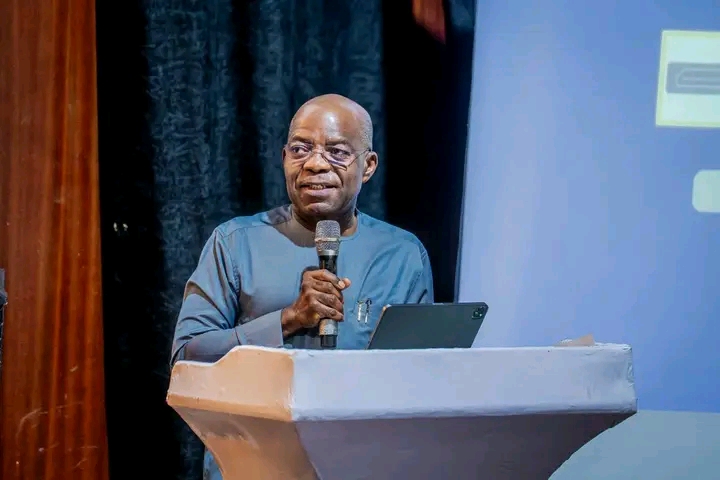
Abia State Governor, Dr Alex Otti, has described mother-tongue instruction as key to the evolution of education in Nigeria, urging policymakers to confront the practical challenges of teaching children in indigenous languages rather than dismissing research that supports the approach.
Otti made the call on Wednesday, September 23, 2026, while speaking at the 24th Annual Lecture/Symposium of the Fafunwa Educational Foundation and the 19th Annual Post-Doctoral Awards in Education, held at the AGIP Recital Hall, MUSON Centre, Onikan, Lagos.
The symposium, held in honour of the late Professor Aliu Babatunde Fafunwa, Nigeria’s first Professor of Education and former Minister of Education, had as its theme, “What Does the Research Say?: Mother Tongue Instruction and the Future of Early Education in Nigeria.” The theme placed at the centre of national conversation the question of what language Nigerian children should first encounter as the language of formal learning.
Otti, who chaired the event, said research indicating that children learn better when taught in indigenous languages should not be rejected merely because it challenges existing assumptions about education.
“While it is fine to disagree with the findings of a research work, it is, however, not acceptable to reject a viewpoint for the simple reason that agreeing with the facts challenges individual biases and ego,” he said.
He acknowledged that mother-tongue education comes with practical difficulties, including the shortage of teachers fluent in indigenous languages and the question of the relevance of a local language outside a child’s immediate community. But, rather than allowing those difficulties to invalidate the idea, he argued that Nigeria should find ways of overcoming them.

The governor cited China, India and South Korea as examples of countries where children have received foundational education in indigenous languages while their societies have gone on to make significant economic and technological advances.
“If children and professionals in China suffer no disadvantage from learning in Mandarin, just like their counterparts in India or South Korea who started their learning in indigenous languages, then the fears against the use of indigenous languages for early-stage education in this part of the world may be exaggerated at best,” he said.
Otti, however, admitted that he was not an expert in language or early-childhood education and therefore did not intend to make definitive pronouncements on the subject. Rather, he said, the purpose of the gathering was to allow scholars and practitioners to interrogate the evidence and provide insights that could ultimately guide education policy.
He also used the occasion to celebrate Fafunwa’s legacy, describing him as “a man of ideas, a dreamer and pathfinder” who believed in the capacity of the trained mind to accomplish great things. Otti said the annual lecture was important because it kept alive Fafunwa’s ideas and encouraged Nigerians to interrogate existing institutions and assumptions in search of better outcomes.
Delivering the keynote address, Professor Francis Egbokhare of the Department of Linguistics and African Languages, University of Ibadan, gave perhaps the most forceful intellectual argument for mother-tongue instruction. He said the language through which a child first encounters formal education is not a neutral administrative choice but one of the most consequential decisions an education system can make.
Drawing from his own childhood experience, Egbokhare recalled how a misunderstanding of English terminology affected his understanding of a mathematics lesson. What appeared to the teacher to be a simple mathematical exercise became confusing to a child whose mental world was framed in another language. For him, the experience illustrated how what is sometimes regarded as poor academic ability may actually be a language problem. Recent reports of the lecture similarly identified the mismatch between the language of instruction and the
language understood by learners as a major factor in Nigeria’s learning crisis.
Egbokhare stressed that mother-tongue instruction should not be confused with abandoning English. Rather, he advocated a bilingual approach in which children first develop strong cognitive and conceptual foundations in languages they understand before acquiring English more effectively. He questioned a system in which a child could be taught through one language but assessed in another, describing such a situation as fundamentally confusing.
He argued that Nigeria’s problem was less the conceptual validity of mother-tongue education than its implementation. Questions about which language should be used in multilingual classrooms, how teachers should be trained, where textbooks should come from and how children should be assessed, he said, were logistical challenges that could be solved.

Egbokhare also challenged the perception that Nigeria’s linguistic diversity makes mother-tongue education impossible. He argued that the country needs better data on how Nigerians actually use languages, noting that linguistic behaviour is dynamic and has been transformed by migration, urbanisation, technology and changing family structures.
According to him, universities and other institutions of higher learning could become centres for developing indigenous-language teaching materials, training teachers and deploying technology to support multilingual education. He warned that Nigeria risked creating a generation caught between English and indigenous languages, competent in neither, unless the country treated language as an essential component of educational development rather than a peripheral issue.
In a goodwill message delivered on behalf of her mother, Chief Mrs Doris Fafunwa, Professor Sheri Fafunwa-Ndibe reflected on the personality and philosophy of her late father, recalling a man who she said was an “unrepentant optimist” who welcomed challenges and confronted them with patience and determination.
She said Fafunwa was never afraid of controversy and consistently worked in the interest of what he considered the deprived majority rather than the privileged few. Among the causes closest to his heart, she noted, was the teaching of children in their mother tongues, which he believed could give pupils greater confidence and improve their academic performance as they progressed through school.
According to her, Fafunwa’s commitment to education was not confined to theory. From teaching and developing faculties of education to his work in national education administration and as Minister of Education, he continually sought ways of improving the educational fortunes of Nigerians. His work, she said, reflected his belief that education was ultimately about the common good.

Sheri said her father’s life also demonstrated the power of individual possibility. He believed that what one person could accomplish was an indication of what others could discover and achieve in themselves.
She described him as a man whose love extended from his family and friends to Nigeria and humanity at large, saying his life should continue to inspire younger generations. Her message therefore fitted neatly into the central argument of the symposium: that Fafunwa’s legacy was not merely a collection of academic writings but a continuing challenge to Nigerians to rethink education in ways that put the child and the society at the heart of policy.
For Professor Okey Ndibe, the occasion also offered an opportunity to introduce a new generation to the extraordinary life of his father-in-law through his newly published book, Babs Fafunwa: A Life of Firsts – A Mini-Biography for Youngsters, illustrated by his son, Chibu Ndibe. The book was presented at the event and is aimed particularly at younger readers.
Ndibe said his decision to write the book grew from years of listening to Fafunwa’s stories and reading his numerous books. He described the late educationist as a man who rose from modest circumstances to become one of Africa’s most distinguished scholars and education policymakers.
He recalled that Fafunwa went to the United States in 1948, where he supported himself through difficult jobs, including cutting grass, working in kitchens and carrying cement at construction sites. Yet, despite these hardships, he completed his first degree at remarkable speed and went on to earn a master’s degree and doctorate in education.
Ndibe said Fafunwa subsequently accumulated a remarkable series of “firsts” in his academic and professional career, including becoming the first head of the Department of Education at the University of Nigeria, Nsukka, and later playing significant roles in the development of education at the University of Ife, now Obafemi Awolowo University.
He also recalled the words of the late literary giant Chinua Achebe, who, following Fafunwa’s death, told him that he should be proud of a father-in-law who “kept his name” in a country where people were often willing to compromise their integrity for material gain.
Ndibe said the 72-page book, originally conceived as a much shorter biography, was written to ensure that young Nigerians could encounter Fafunwa not merely as a historical figure but as a human being whose struggles, achievements, integrity and commitment to education could inspire them.
He said all proceeds from the sale of the book would go to the Fafunwa Educational Foundation. The book was offered at a subsidised price of N5,000 at the event after an anonymous donor contributed towards reducing its production cost. Otti also congratulated Ndibe on the publication and said he looked forward to reading and sharing it with his children.
It was an afternoon of ideas and memory as well of presentation of post-doctoral awards in education, certificates and plaques to deserving scholars. Dr. Ogundowole Ayodeji of Lagos State University won the first prize for his research titled, “Culturo-Techno- Contextual Approach 2.0, Secondary Schools Students Cognitive achievement and Process Skills Acquisition in Biology”. Dr. Tomi Igundipe of the University of Ibadan won the second prize for her research titled, “Development of Interactive Video-based Instructional Packages and its Effect on Pupils’ Learning Outcomes IN Geometry in Osun State”.
Dr Ishola Ayoade Joshua of Ekiti State University, Ado-Ekiti won the third prize for “ Socio-Emotional Intelligence, Metacognition, Creativity and Academic Performance Among Secondary School Students in North Central Nigeria.

The convergence of the four contributions at the MUSON Centre gave the 2026 Fafunwa lecture an unusual resonance. Otti approached the subject from the standpoint of policy and evidence; Egbokhare from linguistics and cognitive development; Sheri Fafunwa-Ndibe from the memory of Fafunwa’s life and convictions; and Ndibe through the prism of biography and the responsibility of passing a legacy to younger Nigerians.
The message running through the proceedings was that the debate over mother-tongue education is not simply about replacing English with indigenous languages. It is about determining how Nigerian children can acquire knowledge most effectively while retaining a meaningful connection with their linguistic and cultural environments.
For Otti, the task now is to interrogate the evidence, confront the practical obstacles and develop policies capable of translating research into classroom practice. For Egbokhare, the urgency is even greater: Nigeria’s education system must resolve the language gap if it is to address the learning crisis confronting millions of children.
And in remembering Fafunwa, the speakers returned repeatedly to the idea that education is ultimately an investment in human possibility. The challenge before Nigeria, therefore, is not simply whether to teach children in their mother tongues, but how to build an education system in which language ceases to be a barrier to learning and becomes an instrument for unlocking the intelligence of the Nigerian child.