
Fela Debates: Opposition candidates present agendas for Lagos ahead of 2027 polls
By Nehru Odeh
With the 2027 governorship election approaching, opposition candidates in Lagos State have outlined their visions for the state, promising improvements in education, healthcare, housing, transportation, electricity and waste management, while calling for greater accountability in governance.
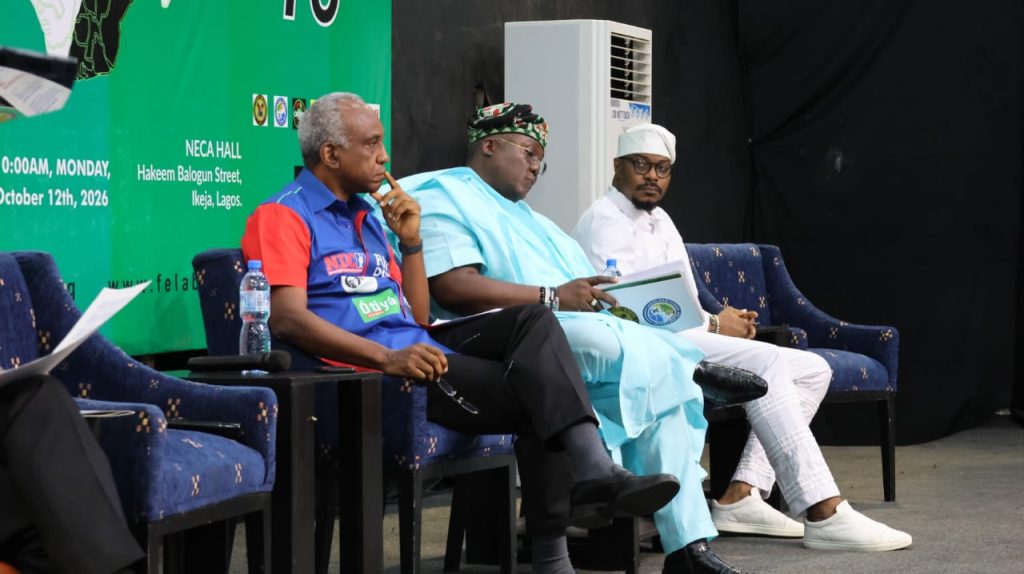
The candidates spoke on Monday, October 12, at The Fela Debates, organised as part of activities marking this year’s Felabration, the annual celebration of the life and legacy of Afrobeat pioneer Fela Anikulapo-Kuti. The event, themed Elections 2027: Who Are You Re?, brought together political candidates, civil society advocates and citizens to examine the issues shaping Lagos and the choices before its electorate.
The speakers included Yemi Adamokekun, an active citizen advocate and thought leader; Chief Gbadebo Rhodes-Vivour, governorship candidate of the African Democratic Congress (ADC); Funsho Doherty of the Nigeria Democratic Congress (NDC); and Engr. Adedeji Doherty of the Peoples Democratic Party (PDP).
Drawing inspiration from Fela’s music and political philosophy, the speakers addressed the challenges facing Lagos, with particular emphasis on the need to measure government performance by its impact on the lives of ordinary residents rather than by infrastructure projects or revenue figures alone.

Opening the discussion, Yemi Adamokekun challenged the candidates to approach governance through what she described as a framework of people, planet and prosperity, adding a fourth consideration: consequences. She argued that political promises must be evaluated by asking who benefits from government policies, how they affect the environment, who pays for them and who is held responsible when public officials fail to deliver.
Adamokekun warned that Nigeria’s governance challenges were compounded by a culture in which wrongdoing increasingly attracted little shame or accountability. From politicians who misappropriate public funds to contractors who execute substandard projects and public officials who evade responsibility, she argued that the country’s condition reflected the cumulative consequences of individual and collective choices. To change the system, she said, citizens must demand better and make choices that serve the wider public interest.
On urban planning and social welfare, she questioned the quality of data available to guide government policies, citing the displacement of residents in Makoko and the vulnerability of children living on the streets. She noted that estimates of the number of people displaced by the Makoko demolitions varied widely, making it difficult to determine the scale of the humanitarian challenge. She also asked how the government could adequately protect vulnerable children if it did not know how many there were, where they lived or what circumstances had brought them onto the streets.
Turning to infrastructure and the environment, Adamokekun raised concerns about flooding, wetland reclamation, transportation and the performance of public projects. She questioned the gap between the capacity envisaged for Lagos’ Blue Line rail service and its reported passenger numbers, while lamenting the decline of the Bus Rapid Transit system. She also called for greater accountability in road maintenance, better coordination of taxation and stronger civil service institutions. Candidates, she said, should explain not only what they intended to accomplish but also who would bear the consequences if they failed. Her central message was that governance must be judged by its effects on people’s lives, the environment and economic opportunities.
Gbadebo Rhodes-Vivour, the ADC governorship candidate, anchored his presentation in Fela’s music, using lyrics from the Afrobeat pioneer’s repertoire to examine leadership, education, economic opportunity and the future of Lagos. He argued that Nigerians must reject the assumption that poor public services and mediocre leadership were inevitable features of life in Africa. Invoking Fela’s line, “Teacher, don’t teach me nonsense,” he called for a fundamental shift in the education system, with greater emphasis on critical thinking, practical skills, production and an African-centred understanding of history.
Rhodes-Vivour said his proposed administration would prioritise human capacity development, including vocational training centres at ward level. The centres, he explained, would be informed by data gathered from local communities so that training reflected residents’ actual needs and economic interests. Referring to a survey conducted through the Our Lagos Foundation, which he launched on his birthday the previous year, he said between 46 and 47 per cent of respondents expressed interest in agriculture. He said the initiative demonstrated the importance of gathering information directly from the people government intended to serve. He also proposed free vocational training and feeding arrangements to enable participants to acquire skills without losing the means to support themselves.

The ADC candidate linked skills development to employment, security and housing, arguing that young people drawn into street-level political activities and other unproductive pursuits needed viable economic alternatives. He proposed delivering 100,000 housing units within four years, drawing inspiration from the administration of former Lagos governor Lateef Jakande. His approach, he said, would involve bulk procurement of building materials and the employment of local labour to reduce costs and stimulate local economies. He also advocated decentralising development, expanding rail transportation and improving waterways to reduce commuting times and make housing more affordable. He claimed that Lagos could develop its rail lines simultaneously within two and a half years, provided the necessary rights of way and financing arrangements were secured.
On the environment and public services, Rhodes-Vivour criticised the state’s waste management arrangements, arguing that collecting and dumping refuse was not an adequate waste management strategy. He advocated recycling, upcycling and converting waste into energy, with local governments playing a more active role in the process. He also called for stronger wetland protection to address flooding and criticised demolitions that leave residents displaced. Water supply, he added, remained a major concern despite Lagos’ abundant water resources and the existence of projects intended to improve access. He argued that government should focus less on revenue collection as a measure of success and more on affordable housing, primary healthcare, clean surroundings, reliable infrastructure and the overall welfare of residents.
Funsho Doherty, the NDC governorship candidate, placed the welfare of citizens at the centre of his presentation, drawing on Fela’s 1981 song Original Sufferhead to argue that governance must address the everyday hardships of ordinary people. He maintained that government performance should be measured by improvements in people’s lives rather than by the number of bridges built, roads constructed or revenue generated. Citing the constitutional principle that the security and welfare of the people are the primary purposes of government, he challenged the tendency to celebrate Lagos’ internally generated revenue without examining what residents receive in return.
Doherty questioned whether the state’s considerable revenue had translated into better public education, accessible healthcare, adequate housing, reliable electricity and affordable transportation. He recalled growing up in Yaba, Lagos, where water flowed from the taps in his family home in 1981, and contrasted that experience with the difficulties many residents face accessing public water supplies today. He argued that the state’s financial resources should be reflected in measurable improvements in living standards, including lower maternal and child mortality, better outcomes in public examinations and a reduction in the number of people living in slums.

Outlining his programme, Doherty said his manifesto contained specific commitments intended to make government more responsive to residents’ needs. Among his proposals were genuinely free education through secondary school, including textbooks and examination fees; a nutritious meal for every child in public school on school days; and transportation support for pupils who need it to get to school. His wider agenda, unveiled before the debate, also included expanding affordable housing, improving public transport and supporting employment and small businesses. He said each policy was developed with particular residents and the problems they faced in mind, rather than as an abstract government target.
Doherty also stressed the importance of accountability and an effective civil service, arguing that even well-designed policies would fail if the institutions responsible for implementing them were compromised by patronage and a lack of merit. He called for public officials to be held responsible for unlawful decisions and failed commitments, while urging a system that attracts capable young people into public service. He also highlighted the need for cooperation among the executive, legislature and judiciary, supported by a professional civil service. For him, the test of leadership was whether government could improve citizens’ welfare and provide transparent evidence of its performance.
Engr. Adedeji Doherty, the PDP governorship candidate, drew on his long involvement in politics and business to argue that many of Lagos’ fundamental problems had persisted for decades despite successive elections and changes in political leadership. Recalling that he began seeking the governorship at a young age, he said manifestos he had produced in earlier years continued to address problems that remained unresolved. He cited Fela’s Beasts of No Nation and Suffering and Smiling as works that captured the contradictions of Nigerian society, including the tendency of leaders to criticise the people while failing to address their hardships. He also invoked the familiar image of overcrowded public transport to illustrate the persistence of Lagos’ transportation challenges.
Introducing himself as a businessman who entered politics in 1998 and had remained committed to the PDP, Doherty argued that Lagos’ economic importance made effective governance in the state critical to Nigeria’s wider development. He referred to the state’s substantial revenue growth in recent years but maintained that improved public finances had not translated into a corresponding improvement in the daily lives of residents. He said the priority of his administration would be to make life more affordable, increase economic opportunities and ensure that public resources delivered tangible benefits. Drawing on his experience restructuring businesses and dealing with debt, he said government needed to manage its finances carefully while identifying practical ways to support residents and businesses.
In healthcare, Doherty proposed partnerships with major pharmaceutical manufacturers to reduce the cost of medicines and expand access to affordable drugs. Under his proposed arrangement, the state would work with pharmaceutical companies to establish dispensaries across Lagos, while registered residents would receive identification cards that would enable them to obtain medicines at reduced prices. He said the arrangement would be designed to benefit workers across different occupations, including drivers, mechanics and carpenters. His proposal reflected a broader argument that government should use partnerships with the private sector to reduce the cost of essential services rather than relying exclusively on public expenditure.
Doherty also identified electricity as a critical driver of economic growth, noting that the cost of running generators and purchasing diesel increased operating expenses for businesses, including music studios and other creative enterprises. He proposed engaging power-sector operators to examine their financial and operational challenges, with the state considering investments in exchange for equity where appropriate, provided such arrangements could help lower costs for consumers. He said infrastructure, roads, housing and other services remained important, but insisted that the ultimate goal should be to improve the welfare of Lagosians and those who deliver public services, including doctors, nurses, teachers and civil servants. He concluded by urging a more practical approach to governance, centred on affordability, economic opportunity and better service delivery.

Fela’s Legacy and the 2027 Choice
Across the presentations, a common theme emerged: Lagos’ next administration must demonstrate that its revenue, infrastructure and economic strength are translating into better living conditions for its residents. While the candidates differed in their proposed approaches, education, healthcare, housing, transportation, employment, environmental protection and public accountability featured prominently in their addresses.
The debate also reflected the continuing relevance of Fela Anikulapo-Kuti’s political legacy. Through music that challenged authority, exposed social inequality and questioned the conduct of those in power, Fela insisted that citizens had a responsibility to scrutinise government. The speakers sought to carry that tradition into the 2027 election cycle by placing policy proposals and public accountability at the centre of the conversation.
For Lagos voters, the challenge will be to examine these promises, assess their feasibility and determine how each candidate intends to finance and implement the proposed programmes. Ultimately, the question posed by the debate’s theme—Elections 2027: Who Are You Re?—was not simply about the identities of those seeking power, but about their priorities, their capacity to deliver and the standards by which they should be held accountable.