
5 unusual things that marked Toluwanisings’ burial
By Tolulope Oke
The burial of popular Nigerian gospel singer Olayemi Bolaji, widely known as Toluwanisings, took place in Ibadan, Oyo State, on Monday, November 9, 2026.
However, beyond the tears and tributes, several unusual developments marked the singer’s final farewell, which came nearly four weeks after his death on October 14.
From police intervention in a family dispute to tight restrictions on funeral coverage, here are five things that stood out.
1. Police had to settle a family dispute before the burial
Unlike most funerals, Toluwanisings’ burial was preceded by a disagreement between his widow and paternal relatives over where his remains should be laid to rest.
The disagreement became so serious that the Oyo State Police Command intervened.
On November 3, his widow, father and several associates signed a peace undertaking before the Commissioner of Police.
They agreed to stop public exchanges and social media publications capable of escalating the dispute.
2. His final burial location was missing from the funeral programme
Although the funeral arrangements were eventually announced on the singer’s official social media page, the programme did not reveal where he would be buried.
It provided the venue and times for the lying-in-state and funeral service but omitted the location of the interment.
The programme was also released on the day of the burial.
3. He was eventually buried inside his residential compound
Despite earlier disagreements over whether he should be buried in a cemetery, at his residence or beside his late mother in Osun State, Toluwanisings was eventually laid to rest at his home in Ibadan.
The residence is where his wife and children live.
His father, who had been involved in the dispute over the burial arrangements, was also reported to have attended the ceremony.
4. Heavy security restricted access to the burial
The burial was conducted under unusually tight security.
Police officers were deployed around the funeral venues, while entry to the private interment was restricted to family members and invited guests.
According to the Nigerian Tribune, people admitted to the burial ground had to present passes, while photography and video recording were prohibited.
5. A journalist’s phone was searched over funeral photographs
Perhaps one of the most striking incidents involved a journalist attempting to cover the funeral.
Leadership newspaper reported that its correspondent was stopped from taking photographs inside the funeral venue.
According to the report, a police officer examined the journalist’s phone for pictures and videos before escorting him outside.
The correspondent was eventually allowed to leave with his phone.
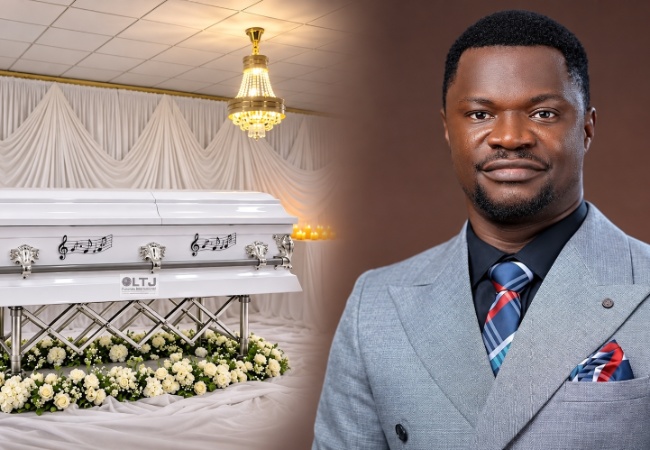
Meanwhile, footage from the public procession showed trumpeters accompanying pallbearers carrying the singer’s white coffin.
The public farewell contrasted sharply with the private interment at his residence, where access was restricted and even neighbours were reportedly absent from the immediate surroundings.