
Oyebanji signs three bills into law
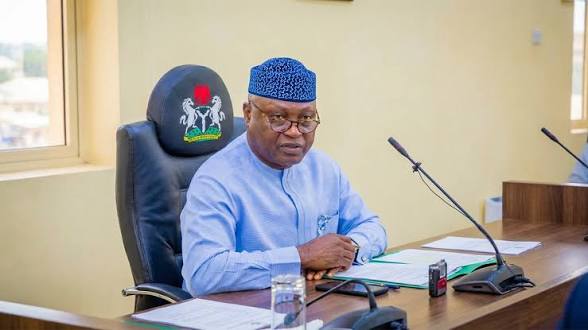
Governor Biodun Oyebanji of Ekiti State on Monday assented to three bills recently passed by the State House of Assembly.
The bills are the 2026 Revised Appropriation Law; the Ekiti State Pension Reform (Second Amendment) Law, 2026 (No. 4 of 2026); and the Ekiti State Right of Way Law, 2026 (No. 5 of 2026).
The News Agency of Nigeria (NAN) reports that the Speaker of the House of Assembly, Adeoye Aribasoye, presented the bills to the governor for assent at his office in Ado-Ekiti.
The 2026 Revised Appropriation Law retains the state’s total budget at N415.57 billion but adjusts the allocations for recurrent and capital expenditure to reflect the government’s financial and operational priorities.
Under the revised budget, recurrent expenditure increased from N221.87 billion to N268.77 billion, while capital expenditure decreased from N193.70 billion to N146.81 billion.
The adjustment represents a reallocation of funds from capital to recurrent expenditure without any increase in the overall budget initially approved in December 2025.
The Ekiti State Pension Reform (Second Amendment) Law, 2026, amends the existing Pension Reform Law No. 3 of 2022 to accommodate the appointment of a Director-General alongside the Permanent Secretary in the administrative structure of the commission responsible for the Contributory Pension Scheme (CPS).
The amendment also revises provisions relating to the composition of the commission’s board, staff administration, remuneration and allowances.
Similarly, the Ekiti State Right of Way Law, 2026, establishes a regulatory framework for granting permits for the installation and maintenance of telecommunications infrastructure across the state.
It sets the maximum Right of Way fee at N145 per linear metre for ducts and cables and N700,000 per site for a Base Transceiver Station.
The law also requires telecommunications operators to comply with approved engineering standards, safeguard public safety and the environment, minimise damage to roads and public utilities, and restore affected infrastructure after installation.
( NAN)