
Beyond the pulpit: Dunamis’ footbridge, roads, boreholes, humanitarian projects across communities
By Abiodun Akinola
Since its founding in 1996, the church led by Paul and Becky Enenche has funded community development and relief projects, mostly in and around Abuja.
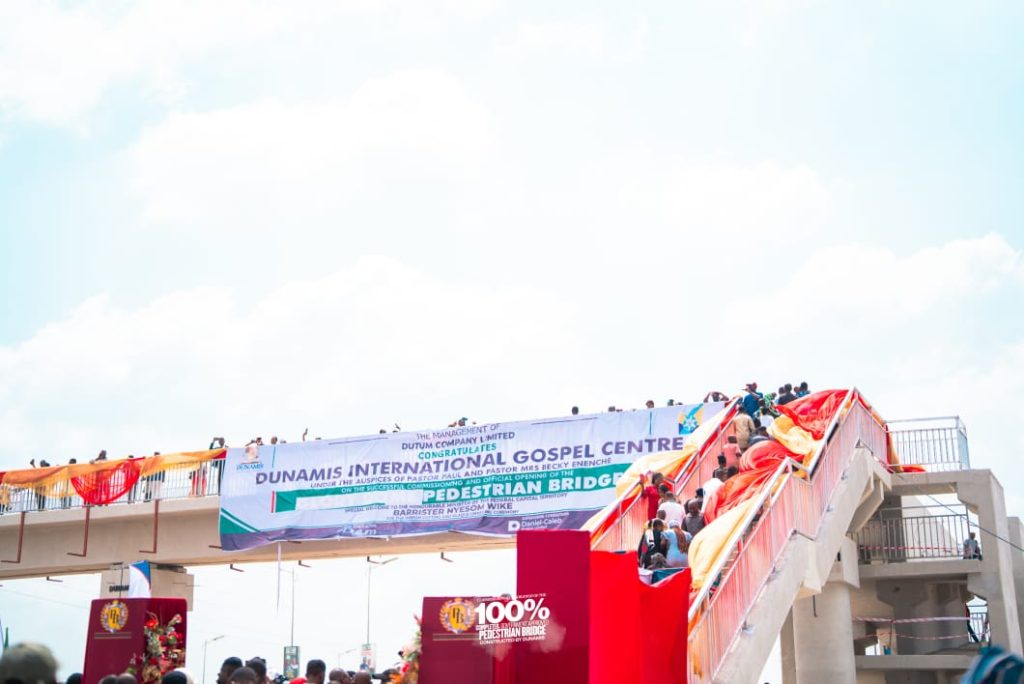
When the Federal Capital Territory (FCT) Minister, Nyesom Wike, commissioned a pedestrian bridge on Abuja’s Airport Road on October 30, he announced that the FCT Administration would refund half of its construction cost.
The bridge was built by the Dunamis International Gospel Centre, founded in 1996 by Paul Enenche and his wife, Becky, both trained physicians.
Paul Enenche was born on June 4, 1968, in Otukpo, Benue State. A graduate of Medicine and Surgery from the University of Jos, where he completed his studies in 1993, he has remained passionate about making a positive impact on society through philanthropy.
The pedestrian bridge is the latest in a series of community development and relief projects undertaken by the couple and their church over the years, largely in and around Abuja.
The bridge
Wike said the church applied for approval to construct the bridge in 2018, but the request only reached him in February 2026. He added that approval was granted within a month.
He described the project as a model of corporate social responsibility and announced that the FCT Administration would refund 50 per cent of the construction cost. He also criticised pedestrians who ignore footbridges and continue to cross highways on foot.
Enenche said the church embarked on the project because of frequent fatal accidents along the road. He added that the church plans to improve the facility with a covered walkway, lighting and transparent side panels.
The News Agency of Nigeria reported that construction began on June 22, 2026, and took about four months to complete. Senator Ireti Kingibe, who represents the FCT, also attended the commissioning.
Water and roads
Newspaper reports dating back to 2022 have documented several borehole projects funded by the church in different communities.
These include Wukara and other FCT communities in June 2022, Kuyami in October 2022, Piwoyi in 2024 and Sabon Iddo in June 2025.
In Kubwa, Enenche commissioned a 1.2-kilometre township road and a renovated classroom block at a government secondary school, according to Daily Trust.
In 2026, Enenche told the News Agency of Nigeria that the church had also constructed roads in Mararaba, Karu and Kubwa, as well as drilled boreholes in Borno State.
Healthcare and relief for displaced people
Both Enenche and his wife practised medicine before going into full-time ministry, and several of the church’s outreach programmes include medical services.
During an outreach in Sabon Iddo in June 2025, health workers treated people for hypertension, diabetes, malaria and childhood infections, according to Leadership.
Following the 2024 flooding in Maiduguri, the couple visited the city, met with Borno State Governor Babagana Zulum and attended to displaced people at a camp, the newspaper reported.
In Benue State, they delivered a truckload of relief materials to the Daudu camp in January 2018. In June 2025, they also visited Yelwata following an attack and distributed relief items to affected residents.
However, aid provided to camps in Benue has not always reached those it was intended to benefit.
Support for widows, orphans and skills development
The church’s welfare department runs regular support programmes for vulnerable people.
At Christmas in 2024, the church reported providing assistance to about 5,000 people, including 540 widows. A church coordinator said the widows’ ministry had organised such programmes every Christmas since 2011.
In June 2025, a total of 514 widows and 10 orphanages received food and other relief materials at the church’s headquarters.
A skills acquisition programme organised in 2023 was also reported to have benefited more than 520 orphanages and less privileged people.
Becky Enenche’s birthday programmes, held every October, have followed a similar pattern of supporting vulnerable groups.
In 2022, she distributed sewing machines, grinding machines and ovens, alongside ICT training, to about 600 widows, orphans and young people.
In October 2025, she extended support to more than 30 orphanages and over 1,000 children, including through scholarship programmes.
She has maintained that the scholarships she provides are separate from those funded by her husband or the church.
Faith-based organisations and community development
The activities of Dunamis take place within a wider Nigerian environment where faith-based organisations frequently provide assistance in areas where public social services remain inadequate.
Churches, mosques, charitable foundations and other religious organisations often support families with school fees, food, healthcare, emergency relief and assistance during periods of insecurity or natural disasters.
Such interventions provide immediate support to people who might otherwise struggle to access essential services.
Wike’s endorsement of the Airport Road pedestrian bridge and his pledge to refund half of its construction cost also reflect an approach in which the government encourages private organisations to contribute to public infrastructure.
His position that the government cannot shoulder every development responsibility alone highlights the growing importance of cooperation between public authorities, private organisations and civil society.
However, such partnerships require clear procedures, accountability and proper maintenance to ensure that projects deliver lasting benefits to the public.
For Dunamis International Gospel Centre, the pedestrian bridge has brought one of its community development projects into the public spotlight. However, the church’s reported interventions extend far beyond the highway.
From borehole drilling and road construction to medical outreaches, school rehabilitation, scholarships, relief for displaced families, support for widows and orphans, vocational training and rehabilitation initiatives, the projects cover several areas of community welfare.
Ultimately, the value of these efforts will not be measured by the number of ceremonies held or announcements made, but by the extent to which the projects continue to improve the lives of the people they were designed to serve.
In the final analysis, a footbridge is judged by the lives it helps protect, a borehole by the water it continues to provide, a scholarship by the future it helps secure, and humanitarian assistance by whether it reaches those who need it most.