
Lagos increases HIV budget by 35%, begins distribution of antiretroviral drugs
The Lagos State Government has increased its approved HIV budget by 35 per cent to ₦1.065 billion and commenced the distribution of government-procured antiretroviral drugs, as it moves to strengthen local funding and protect treatment services amid changing global financing conditions.
The development signals a renewed push by the state to reduce its dependence on external support and ensure uninterrupted access to essential HIV medicines and healthcare services for people living with the virus.
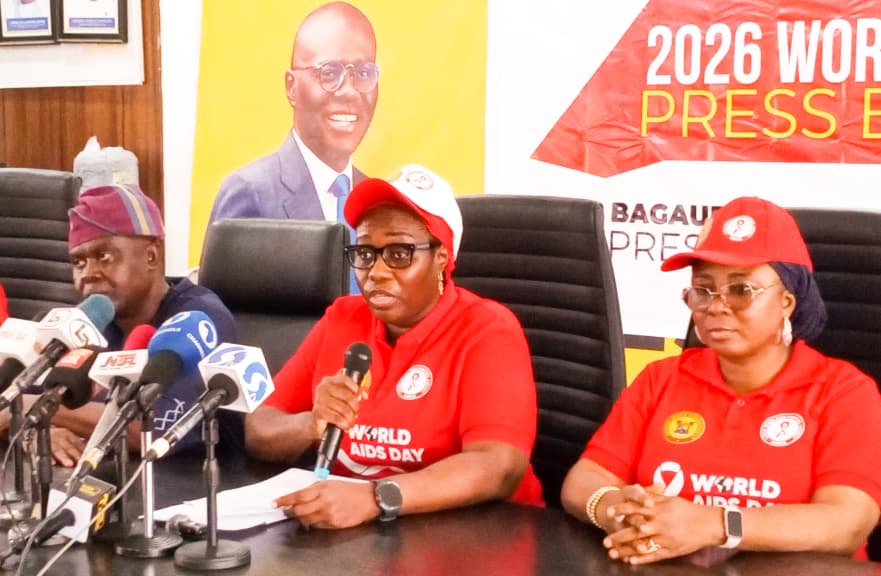
Chief Executive Officer of the Lagos State AIDS Control Agency (LSACA), Dr. Folakemi Animashaun, disclosed this on Thursday during a press briefing at the Baguada Kaltho Press Centre, Lagos, to announce activities marking the 2026 World AIDS Day.
Animashaun said the approved state HIV budget increased from approximately ₦791 million to ₦1.065 billion in 2026, representing an increase of about 35 per cent.
She described the development as an important demonstration of the government’s growing commitment to domestic ownership of the state’s HIV response, particularly as changing international funding arrangements raise concerns about the sustainability of essential health programmes.
“The contribution of development partners to the HIV response has been immense. Their support has saved lives, strengthened institutions and expanded access to essential services.
“However, changing global financing conditions remind us that protecting the lives of our people requires resilient local institutions, predictable resources and stronger domestic responsibility,” she said.
The agency’s CEO disclosed that the Lagos State Government had also procured antiretroviral medicines, with LSACA already commencing their distribution to bring essential drugs closer to people who depend on them.
She stressed that maintaining uninterrupted access to treatment was critical to protecting the health and wellbeing of people living with HIV, warning that the success of the initiative would depend on effective forecasting, quality assurance, distribution and stock monitoring.
“For people living with HIV, uninterrupted treatment is essential to their health, wellbeing, ability to live productive lives and ability to care for their families,” Animashaun said.
She added that the state’s procurement initiative was designed to complement existing national and development-partner arrangements while strengthening Lagos’ participation in securing essential HIV commodities.
Beyond increased budgetary allocation and medicine procurement, she said the government is developing a 10-year HIV Response Transition and Sustainability Roadmap covering 2027 to 2036.
According to Animashaun, the roadmap will provide a framework for strengthening domestic financing, healthcare delivery, human resources, access to medicines and diagnostics, programme information, community participation and institutional accountability.
She said the roadmap was expected to be formally launched by Governor Babajide Sanwo-Olu at the World AIDS Day Symposium scheduled for December 1, 2026, subject to the necessary approvals.
The symposium is also expected to feature the formal presentation of antiretroviral medicines procured by the state government.
Providing an update on the state’s HIV response, Animashaun said consolidated programme records showed 387,558 HIV-negative test results and 7,584 HIV-positive test results.
She, however, clarified that the figures represented reported test results and should not be interpreted as the number of new infections or necessarily as unique individuals.
She also disclosed that the maternal health programme recorded 156,122 new antenatal care clients and 156,109 HIV-negative test results among pregnant and breastfeeding women.
“At the community level, 25,167 HIV tests were conducted among people aged 15 and above between January and October 2026, producing 1,166 positive results,” she disclosed.
Animashaun said the figures demonstrated the scale of the state’s testing activities but maintained that the real measure of success was the ability to link people who test positive to treatment, retain them in care and improve their health outcomes.
She identified stigma, discrimination, financial constraints and other barriers as challenges preventing some residents from accessing HIV prevention, testing and treatment services.
“No one should be afraid to seek healthcare because of their HIV status. No one should be denied dignity because of a health condition. And no one should be made to feel that their HIV status diminishes their worth as a human being,” she said.
The LSACA chief executive also called on residents to know their HIV status and take advantage of available prevention services, including condoms, HIV testing, pre-exposure prophylaxis and post-exposure prophylaxis where medically indicated.
She explained that people living with HIV who take effective treatment and maintain an undetectable viral load cannot transmit the virus sexually, a principle known as Undetectable Equals Untransmittable.
The briefing marked the commencement of Lagos State’s 2026 World AIDS Day activities, themed “Ending AIDS Starts with Access: Equity, Ownership and Sustainability.”
The programme will feature a fitness walk and awareness rally, a novelty football match at Campos Stadium, Lagos Island, an empowerment programme for people living with HIV, religious services and a symposium on December 1.
Animashaun said the state would continue working with development partners, healthcare institutions, community organisations and other stakeholders to strengthen HIV prevention, treatment and care.
She emphasised that the government’s priority was not merely to increase spending or procure medicines but to establish a dependable healthcare system capable of protecting people living with HIV regardless of changes in external funding.
“Ending AIDS is not simply about what we achieve today. It is about whether we have the courage, commitment and responsibility to sustain those achievements tomorrow,” she said.