
Ogun governorship: APC’s Adeola targets 100,000 jobs annually
By Adejoke Adeleye
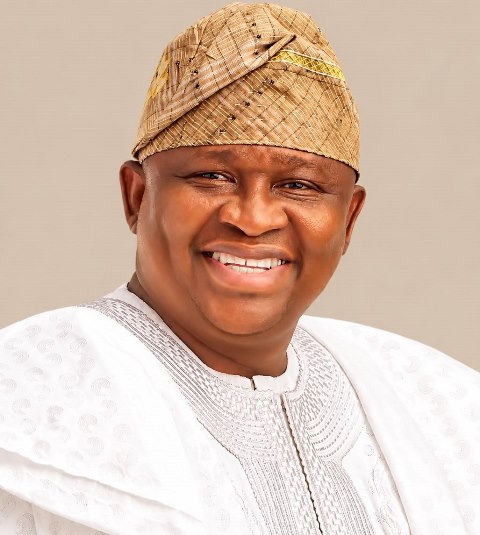
The All Progressives Congress (APC) governorship candidate in Ogun State, Senator Solomon Olamilekan Adeola, popularly known as Yayi, has set a target of creating 100,000 jobs annually in the state if elected.
Adeola who made the promise while presenting his manifesto to his supporter in cultural center, Abeokuta said Ogun State is strategically positioned to become one of Nigeria’s leading economic destinations, citing its proximity to Lagos, the Atlantic Ocean and the Republic of Benin as major advantages.
He described Ogun as a state standing at the cusp of greatness, arguing that its economic gap with Lagos was not a result of inadequate human resources or potential but weaknesses in planning, organisation and revenue mobilisation.
According to him, Ogun’s economy is estimated at ₦17 trillion, with a per capita income of approximately $1,740, which he said was higher than the Nigerian average of about $1,220.
The APC candidate, however, expressed concern that despite the state’s economic potential, many residents continued to struggle with inadequate electricity, unemployment, poor healthcare services and agricultural losses.
He said his vision was to transform Ogun’s natural and human resources into sustainable economic prosperity through strategic investments, infrastructure development, agricultural diversification, transparent governance and improved social services.
Unveiling his nine-point ITESIWAJU agenda, Adeola promised to construct and rehabilitate 2,500 kilometres of rural, urban and border-town roads by 2031, ensuring that every local government area was connected to a tarred arterial road.
He also pledged to fully operationalise the Gateway International Agro-Cargo Airport, develop the Kajola and Ijebu-Ode dry ports, and advance the proposed $7 billion-plus Gateway Deep Sea Port and Blue Marine Special Economic Zone in Ogun Waterside.
On transportation, he promised to pursue the extension of Lagos Red and Blue rail lines into Ogun State and introduce commuter train services between Abeokuta and Lagos.
He further proposed the introduction of 50 to 100 Compressed Natural Gas (CNG) buses within 12 months of assuming office, alongside an integrated mass transit system covering major routes, including Abeokuta, Sango-Ota, Mowe-Ibafo, Sagamu and Lagos.
Adeola also promised to address the state’s estimated 600-megawatt electricity deficit, beginning with 200 megawatts of embedded and renewable energy, while expanding solar mini-grids to underserved communities.
Under tourism and creative arts, he pledged to develop 12 flagship tourist destinations, attract 500,000 visitors annually and generate a projected ₦15 billion in revenue by 2031.
He identified Olumo Rock, Bilikisu Sungbo Grove, Ojude Oba, Lisabi and Oronna festivals, as well as coastal attractions in Ogun Waterside, as major tourism assets.
The candidate also promised to establish an Ogun Film Village and promote the state’s film, fashion, music and Adire industries as sources of employment and economic growth.
On education, Adeola said his administration would rehabilitate 2,000 classrooms, construct 500 new educational facilities and train more than 35,000 public-school teachers, while targeting 95 per cent primary school completion.
He added that technology would be integrated into classrooms and curricula modernised to prepare young people for opportunities in the digital economy.
On security, he promised to strengthen the Amotekun Corps, reposition the state’s Security Trust Fund, establish a Joint Intelligence Fusion Centre and deploy CCTV cameras and drones across major towns and border communities within three years.
He also pledged to prepare Ogun for a smooth transition to a state police structure when the necessary national legislation was finalised.
In the health sector, Adeola promised to equip primary healthcare centres across all wards, establish a Centre of Medical Excellence in each senatorial district and enrol two million residents in health insurance by 2031.
He said his administration would also introduce mobile healthcare programmes to reach underserved communities and reduce maternal mortality to below 200 deaths per 100,000 live births.
Under women and youth empowerment, the APC candidate promised to train 100,000 young people in digital skills and another 100,000 women in practical vocational skills.
He proposed a ₦10 billion Enterprise and Empowerment Fund to support 60,000 women- and youth-owned businesses, while pledging that women would occupy at least 30 per cent of senior government appointments.
Adeola further promised to support 20,000 widows, elderly people, persons living with disabilities and low-income families through a social safety net programme.
On agriculture, he said his administration would double the proportion of cultivated arable land in Ogun from the current 30 per cent to 60 per cent under the Grow Ogun, Feed Nigeria initiative.
He proposed the establishment of cocoa hubs in Ogun East, cashew hubs in Ogun West and oil palm hubs in Ogun Central, alongside agricultural mechanisation, irrigation, improved financing and market access for farmers.
He also promised to build on the $250 million dairy investment already secured, protect forest reserves against illegal logging and make the Imala Cattle Hub fully operational to address farmer-herder conflicts.
Under job creation and industrialisation, Adeola pledged to generate more than 50,000 formal jobs annually through industrial development, logistics, manufacturing and investment.
He said border communities such as Idiroko, Imeko and Ipokia would be developed into trade and logistics hubs, while an Ogun State Local Content and Skills Development Law would ensure that investments and government contracts created opportunities for indigenous businesses and workers.
He also promised to provide 12,000 apprenticeship and internship opportunities by his fourth year in office.
On urban renewal and environmental sustainability, Adeola promised to develop planned towns along the Lagos-Ogun border, Sagamu-Ijebu axis and Abeokuta-Owode axis.
He said master plans would be prepared for all 20 local government areas, with physical planning desks established in each council to ease access to building approvals.
He also targeted ₦500 billion in private investment for urban renewal and pledged to strengthen waste management, introduce recycling and waste-to-energy facilities, and end open defecation by 2031.
Beyond the nine pillars, Adeola identified six governance catalysts, including fiscal discipline and revenue mobilisation, justice sector reform, legislative reform, civil service reform, asset optimisation and local government autonomy.
He promised to increase Ogun’s internally generated revenue through a single-window collection system, block revenue leakages and improve tax compliance without introducing new taxes or double taxation.
He disclosed that the state’s revenue rose by 136 per cent to ₦238.5 billion in 2025, but noted that federal allocations still accounted for approximately 40 per cent of government expenditure.
The APC candidate also promised to ensure that allocations reached the state’s 20 local government areas directly, fully and on time, in accordance with constitutional provisions.
Setting economic targets for 2031, Adeola projected that Ogun’s per capita income would rise from approximately $1,740 to $2,500, while annual economic growth would increase from about four per cent to between six and seven per cent.
He also targeted an increase in revenue per resident from ₦39,600 to ₦66,000, translating to approximately ₦425 billion annually for reinvestment in the state.
He further promised to reduce the proportion of families living in multidimensional poverty from 68 per cent to below 45 per cent.
To ensure accountability, Adeola said he would establish a Governor’s Delivery Unit within 30 days of assuming office, with commissioners and heads of agencies signing performance agreements tied to the development agenda.
He promised to introduce a public performance dashboard to track six key indicators quarterly, including school completion, electricity access, youth unemployment, maternal mortality, internally generated revenue and access to primary healthcare.
He added that citizens would be able to report service failures and receive responses within 21 working days, while an independent panel would review government performance twice annually.
Addressing the issue of political representation, Adeola said the Yewa-Awori people of Ogun West had waited patiently for 50 years to produce a governor since the creation of the state in 1976.
He declared that his emergence as governor would represent the fulfilment of that aspiration, describing himself as the son of a Yewa father and an Egba mother.
However, he stressed that although his roots were in Yewaland, his responsibility would be to all residents of Ogun State, irrespective of ethnic, geographical or political affiliation.
“My roots are in Yewaland in Ogun West; my duty is to all of Ogun,” he said, describing ITESIWAJU as a statewide development agenda.
He urged residents, investors, farmers, factory owners, traders and young professionals to support the programme, insisting that development must be measured by its impact on citizens rather than the number of projects commissioned.
Adeola called on the people to hold him accountable for the promises, expressing confidence that his proposed administration would deliver infrastructure, economic opportunities and improved living standards.
He concluded with the slogan, “Itesiwaju Ipinle Ogun Lo Je Wa Logun,” meaning the progress of Ogun State is the priority.
Abiodun, who spoke while reviewing his administration’s development initiatives, said the construction of the Gateway International Airport was a strategic decision aimed at accelerating economic growth and positioning Ogun as a major destination for local and international investors.
According to him, the airport was conceived to address a major infrastructure gap and provide the state with the aviation facilities required to support its growing industrial and commercial activities.
He said the airport was completed and commissioned by former President Muhammadu Buhari, after which his administration commenced efforts to operationalise it, including the acquisition of aircraft under the Gateway Air initiative.
The governor disclosed that the airport had facilitated flights to destinations including Mecca, Medina, Banjul and Abuja, describing the development as part of efforts to expand the state’s connectivity and economic opportunities.
Abiodun also highlighted Ogun’s industrial profile, claiming that the state had become the leading cement producer in sub-Saharan Africa and ranked third in Africa.
He further described Ogun as Nigeria’s leading state in non-oil revenue generation, attributing the development to deliberate efforts to strengthen the state’s economy and improve its revenue base.
On investment, the governor said Ogun was experiencing growing interest from investors, citing a recently commissioned $1.8 billion investment as evidence of the confidence businesses were developing in the state.
He maintained that the increasing investment interest was an indication of the state’s expanding economic opportunities and the impact of infrastructure development.
The governor also commended President Bola Tinubu for initiating major road projects, particularly the Lagos-Abeokuta Highway and the Lagos-Calabar Coastal Highway, noting that such projects would improve connectivity and create economic opportunities for Ogun.
He specifically referenced the 71-kilometre Lagos-Abeokuta Highway, the proposed Lagos-Badagry-Sokoto road project, the Sagamu-Benin Expressway and other road interventions, including the Ibadan-Ago-Iwoye and Ijebu-Ode corridors.
According to Abiodun, these infrastructure projects would improve transportation, facilitate the movement of goods and services and strengthen Ogun’s position as an industrial and investment destination.
He expressed confidence that the combination of aviation infrastructure, road connectivity, industrial expansion and improved investor confidence would continue to shape the state’s economic prospects.