
Experts warn lawmakers against hostility, blind support for executive
Leading political scientists have warned that both excessive hostility and uncritical cooperation between the legislature and executive undermine good governance, stressing the need for a balanced relationship that promotes accountability and effective service delivery.
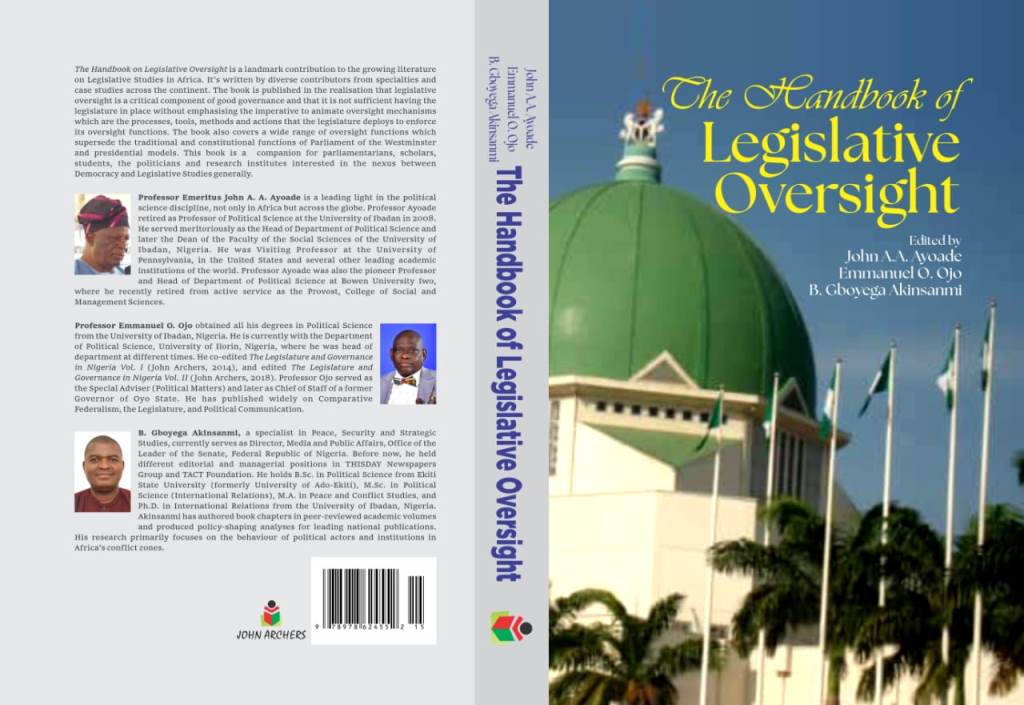
The scholars, Emeritus Professor John Ayoade, Professor Emmanuel Ojo and Dr Babatola G. Akinsanmi, made the observation in a joint statement issued on Sunday to announce the publication of The Handbook of Legislative Oversight, a new book examining the theory and practice of legislative oversight in democratic systems.
They described legislative oversight as a critical component of democratic governance and an essential mechanism for maintaining checks and balances among the three arms of government.
According to them, oversight provides the legislature with the constitutional and institutional means to monitor executive activities, ensure accountability and prevent the abuse of public power.
The scholars warned that legislation without effective oversight could render the legislature irrelevant by allowing the executive to operate without adequate scrutiny.
They maintained that legislative oversight serves as a control mechanism for regulating the conduct of public institutions and safeguarding the interests of citizens.
They stated: “Legislation without oversight essentially nullifies the legislature because it practically lets loose the executive. Oversight, in reality, is a control mechanism that guides the behaviour of public institutions.”
The political scientists further argued that when lawmakers surrender their oversight responsibilities, they undermine not only their constitutional mandate but also their obligation to represent and protect the electorate.
They warned that ineffective, inefficient or compromised oversight could be as damaging to governance as the complete absence of legislative scrutiny.
“A legislature that intentionally or inadvertently surrenders its right and power of oversight abdicates its mandate and compact with the people. Such self-abnegation by the legislature for any reason is a simultaneous betrayal of both the people and the mandate,” they said.
Drawing on empirical evidence from democratic experiences across Africa, the authors also highlighted the delicate relationship between the legislature and executive, arguing that effective oversight requires a balance between cooperation and opposition.
They described this relationship as “cooperative antagonism”, explaining that lawmakers must maintain sufficient independence to hold the executive accountable without turning oversight into unnecessary political confrontation.
According to them, excessive antagonism can make legislative oversight adversarial, while an overly cordial relationship risks transforming the legislature into a rubber stamp for the executive.
Citing the political tensions between former Speaker of the House of Representatives, Ghali Na’Abba, and former President Olusegun Obasanjo as an example of adversarial relations, they warned that either extreme ultimately undermines good governance.
They added that the challenge becomes particularly pronounced when different political parties control the legislature and executive, although a single party controlling both arms does not automatically guarantee effective oversight.
“The three arms are supposed to pursue the common goal of the best service to the people, but what is best may be defined differently, just as the methodology for its attainment,” the scholars said.
They stressed that neither hostility nor unquestioning support should define the relationship between the two arms of government, noting that accountability and collaboration must coexist for democratic institutions to function effectively.
The newly published The Handbook of Legislative Oversight is intended to sensitise lawmakers to their oversight responsibilities and strengthen their understanding of the principles, procedures and practical requirements of legislative scrutiny.
Published by John Archers (Publishers) Limited, the 19-chapter book features contributions from at least 10 professors of law and political science, who examine different dimensions of legislative oversight across the African continent.
The publication explores both horizontal and vertical approaches to legislative oversight, providing insights into how legislative institutions can improve accountability, strengthen democratic governance and deliver better outcomes for citizens.