
Abiodun unveils 2027 budget priorities, targets fiscal sustainability
Adejoke Adeleye Ogun
Ogun State Governor, Dapo Abiodun, has reaffirmed his administration’s commitment to prioritising projects that will accelerate socio-economic growth, strengthen the state’s financial position and improve the living conditions of residents in the proposed 2027 budget.
The Governor also pledged to maintain manageable recurrent expenditure and debt obligations while ensuring that ongoing projects receive realistic funding plans for timely completion.
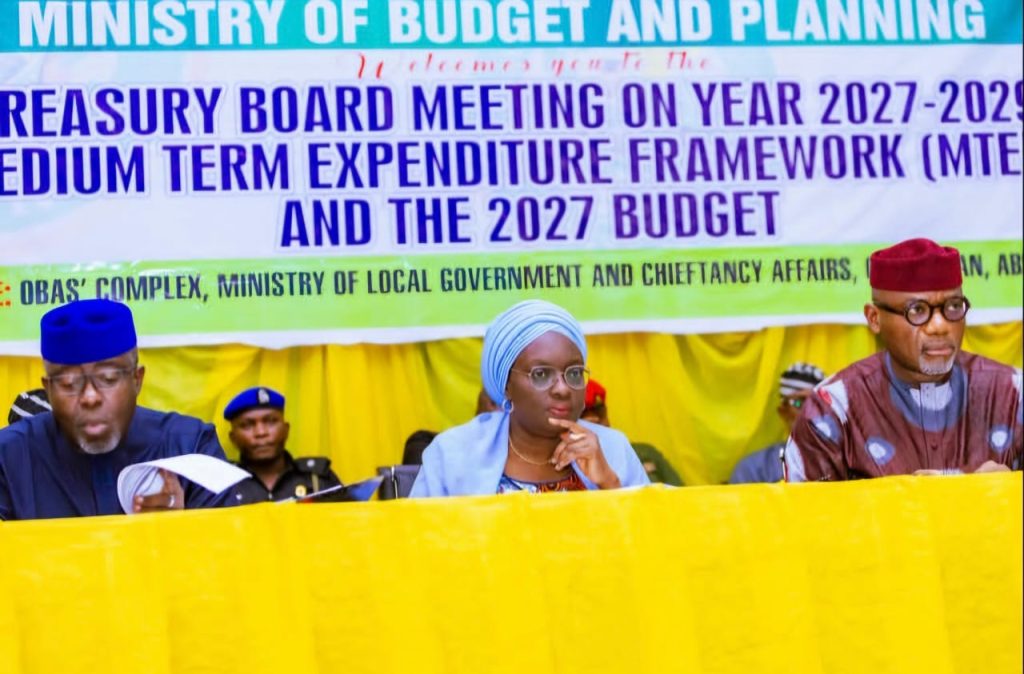
Abiodun stated this on Thursday at the Treasury Board Meeting on the 2027–2029 Medium-Term Expenditure Framework and the 2027 Budget, held at the Oba’s Complex, Oke-Mosan, Abeokuta.
Represented by his Deputy, Engr. Noimot Salako-Oyedele, the Governor said the meeting demonstrated his administration’s commitment to institutional reforms, fiscal transparency, participatory governance and evidence-based planning.
He noted that inputs from citizens and stakeholders during the recent town hall consultations across the four divisions of the state would inform the budget preparation process.
Describing the 2027 budget as a transition budget and the final budget cycle of his administration, Abiodun said the government would consolidate its achievements, advance priority projects and maintain sound financial management to ensure a smooth transition.
“As this is the final budget cycle of our administration, the 2027 budget is the transition budget. We must consolidate our gains, advance priority projects, maintain sound financial management and leave the state in good order for the incoming administration,” he said.
The Governor stressed the need to avoid unfunded commitments, properly account for existing obligations and align development ambitions with available resources.
He added that his administration was determined to leave behind stronger public institutions, improved finances and sustainable reforms capable of delivering tangible benefits to residents.
On revenue generation, Abiodun disclosed that Ogun State’s internally generated revenue had increased from about N52 billion in 2020 to N238.5 billion in 2025, with N259.52 billion already recorded as of October 2026.
He said the administration would continue to reduce dependence on federal allocations through improved IGR performance, while ensuring efficient utilisation of public funds.
According to him, the strategy would help cushion the effects of prevailing macroeconomic challenges and inflation while protecting essential services and productive investments.
Highlighting the impact of infrastructure development on the state’s economic competitiveness, Abiodun listed the Gateway International Airport, Iperu, the Kajola and Ijebu-Ode Inland Dry Ports, the proposed $7 billion Ogun Blue Marine Special Processing Zone, the Deep Sea Port in Ogun Waterside Local Government Area and the proposed $10 billion Olokola Liquefied Natural Gas project as major investments expected to transform the state’s economic landscape.
He explained that the projects would improve connectivity, reduce logistics costs, enhance energy availability, attract domestic and foreign investments, expand the tax base and boost revenue generation.
The Governor also identified four major Federal Government road projects expected to strengthen Ogun’s transport network and open up new economic opportunities.
These include the 700-kilometre Lagos-Calabar Coastal Highway, with a 28-kilometre section in Ogun State; the 1,068-kilometre Sokoto-Badagry Superhighway, which has a 162-kilometre stretch passing through the state; the reconstruction and dualisation of the Ibadan-Ijebu-Ode Road; and the Sagamu-Ijebu-Ode-Benin Expressway.
He said the projects would improve inland and coastal connectivity, reduce travel time and transportation costs, and create opportunities for trade, investment and industrial development.
On youth empowerment, Abiodun said his administration was investing in Information and Communication Technology and digital skills training to equip young people with practical and marketable skills for employment, entrepreneurship and self-reliance.
He further disclosed that over N9 billion had been disbursed to about 203,000 beneficiaries across the four divisions of the state through women empowerment and economic support initiatives.
Speaking on agriculture and food security, the Governor said the administration had provided 10 tractors and other modern farming equipment, rehabilitated processing facilities across the state’s eight farm settlements and distributed fertilisers and seedlings to 3,200 farmers during the wet season and 8,208 farmers during the dry season.
He added that 1,200 Android phones had also been distributed to farmers to support access to climate-related information and improve agricultural productivity.
Meanwhile, Ministries, Departments and Agencies (MDAs) took turns to present their proposed budgets for the 2027 fiscal year.
Also speaking, the Chief Economic Adviser and Commissioner for Finance, Mr. Dapo Okubadejo, attributed the state’s improved budget discipline to the leadership of Governor Abiodun.
He identified the establishment of the Bureau of Public Procurement and the strengthening of the Debt Management Office as key reforms that had enhanced budget implementation and financial accountability.
Okubadejo described the Treasury Board Meeting as an opportunity to review and consolidate the achievements of the present administration while laying a solid financial and institutional foundation for the incoming government.