
Ake Festival returns to Lagos in November with focus on native intelligence
By Nehru Odeh
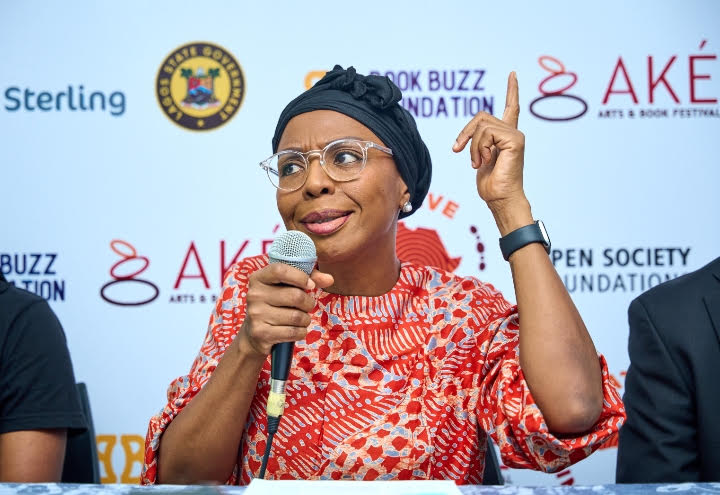
Lola Shoneyin, founder of Book Buzz Foundation and Festival Director of the Ake Arts and Book Festival, has announced that the 14th edition of the literary festival will be held from November 19 to 21, 2026, at SilKwood Hotel (formerly BON Hotel), Ikeja GRA, Lagos.
Shoneyin made this known at a press briefing held at Ouida Bookstore, Opebi, Lagos, on Thursday, October 29, where she unveiled highlights of the three-day festival themed Native Intelligence.
According to her, the festival will feature 24 events, comprising 11 book chats, six panel discussions, poetry performances, music and film screenings, with eight events scheduled for each day.
“As usual, and as has become the winning formula that works, we have eight events taking place on each of those days,” Shoneyin noted.
She explained that the theme would explore indigenous African knowledge systems and their relationship with artificial intelligence, particularly the tendency to privilege formal education over traditional and innate forms of intelligence.
“Those of us who are educated have come to believe that our own intelligence that we have garnered and gained in school is the only kind of intelligence, forgetting that even just 150 years ago, our people were surviving, thriving, creating and inventing before the advent of formal education,” she said.
Explaining what makes this year’s edition unique, Shoneyin said the festival’s ambition was to surpass the achievements of previous editions by presenting an exciting mix of contemporary and established writers and creating platforms for important conversations.
She noted that Ake Festival had consistently distinguished itself through its willingness to address difficult and sometimes controversial issues without being deterred by public opinion.
“As you know, with Ake Festival, we’re not shy. We will have important conversations. We are constantly in pursuit of the unsayable. And that means we want to talk about the matters that are important to us, the things that we want people to take away and remember for months and years after leaving that festival,” she said.
She added that the festival provided an opportunity to centre African experiences, ideas and concerns, rather than allow external perspectives to determine which issues deserved attention.
Among the highlights are a concert featuring Savvy Henry on the opening evening, a screening of How to Build a Library, a documentary featuring Kenyan library advocates Shiro Koinange and Angela Wachuka, and the festival’s popular Palmwine and Poetry evening.
“We do our bits. We bring the poets and we also supply the palm wine, and we expect our incredible audiences to bring the vibe and the noise. And of course, it’s always an incredible event. Last year, we had the privilege of having Professor Wole Soyinka as one of the poets, along with a whole host of incredible poets and musicians from Nigeria and internationally,” Shoneyin enthused.
The festival will also feature prominent Nigerian and African writers, including A. Igoni Barrett, Chika Unigwe, Nnamdi Ehirim, Rukiyatu Brume, Nnedi Okorafor and Wole Talabi, alongside other established and emerging literary voices.
“Chika Unigwe will be joining us to talk about her new book, Grace. It’s also an opportunity to celebrate several incredible authors who live in Nigeria, but also who are coming in from the diaspora. So we have people like Ruki Brume, who was recently longlisted for the Booker Prize. And we have new books like The Most Unremarkable Things, of course, by Khadija Sanosi. We have Communities, Networks, and Ecosystems: How to Build Them and Why They Fail, which was written by Ojoma Ochai.
“We’re going to have that sort of nonfiction conversation as well. We also have Tara, who’s going to be joining us to talk about her own book, and a whole host of authors,” she said.

Shoneyin announced partnerships with the Caine Prize, Granta magazine and the African Speculative Fiction Society. The collaboration with Granta will feature conversations around a special Nigeria edition of the literary magazine, showcasing Nigerian fiction, nonfiction, poetry, photography and interviews.
She said the festival would address contemporary issues, including artificial intelligence and creativity, the future of African literature, and the challenges facing emerging African writers.
Shoneyin particularly expressed concern over allegations of artificial intelligence use against African writers, arguing that differences in language, cultural expression and literary styles should not automatically be interpreted as evidence of AI-generated writing.
Shoneyin said the African Speculative Fiction Society (ASFS) was going to have its own panel. “And that’s the one that really focuses on AI and creativity. And of course, this nasty business of black and brown people around the world who are making it and working hard and writing incredible books, this nasty scourge of them suddenly being accused of using AI.
“I think it’s because they forget that many of us have a language behind the English that we speak, which inevitably influences the way that we speak English. And they don’t get it, but they will get it,” she averred.
She also urged African writers and publishers to build stronger literary institutions at home rather than measure their success primarily by recognition from Western publishing houses.
Shoneyin identified artificial intelligence and creativity as increasingly important issues, noting that although they had been discussed previously, recent developments had made the debate more urgent. Citing the controversy surrounding Jerry Faladi, who reportedly secured a $2 million book deal that was subsequently withdrawn amid allegations that he had used AI to write his book, she said the issue had brought the relationship between artificial intelligence and creative writing into sharper focus. She, however, maintained that the allegations were unfounded.
“Jerry is going to be joining us,” she noted.
“We are the ones that have to do something to our mindset. I am interested in the people that are doing the publishing here. I am interested in our own standards. I am interested in us making literary giants right from here, without the West saying to us, this is how we are supposed to write,” she said.
The festival, supported by Sterling Bank and the Open Society Foundation, will also receive support from the Lagos State Government, which is providing book grants of N20,000 each to 100 young people under 25 to buy books at the festival bookstore.
Shoneyin expressed appreciation to the partners and the Lagos State Government for their continued support, noting that rising international travel and accommodation costs had made organising literary festivals increasingly challenging.
“I would also like to reiterate, as my colleague here said, just how grateful we are to be able to count Sterling Bank as one of our continued partners, and also the Open Society Foundation. I can’t imagine Ake Festival without Sterling Bank now. We are married. And it’s a marriage that has birthed many wonderful children. And long may it continue, because there’s so much that is possible simply because we have a Nigerian partner that we work with.
“I think it’s something that every organisation prays and hopes for, to have a Nigerian company, a Nigerian organisation that is behind you, that supports you, that is interested in your ideas. It is such a gift. And I’m really, really grateful to Sterling Bank.
“And of course, to the Open Society Foundation, as I mentioned as well, they have also been extremely consistent. One of the most difficult things about organising a literary festival in 2026 is buying international flight tickets. It is very difficult, because those tickets at this time are extremely expensive, even accommodating some of our guests to join us.
“When I think of what we used to pay for all the accommodation 10 years ago, compared to what we pay now, it’s a big jump. But without the support that we get, none of that would be possible,” Shoneyin maintained.
Speaking at the briefing, Donatus Okpako, representing Sterling Bank, said the bank’s continued partnership with Ake Festival underscored its commitment to education, literacy, the arts and African culture.
He described the festival as an important platform for young literary minds to acquire knowledge, interact with established writers and engage in conversations that would broaden their intellectual horizons.
According to him, Sterling Bank’s support for the festival is part of its broader commitment to education as one of the critical sectors driving national development.
He said the bank recognised the growing influence of artificial intelligence in education, technology and knowledge production, adding that the festival’s theme provided an opportunity to examine how African knowledge could be preserved, developed and advanced in the emerging technological landscape.
Okpako stressed that bridging Nigeria’s knowledge gap required sustained investment in education and initiatives that encouraged learning, creativity and intellectual development.
He reaffirmed the bank’s commitment to supporting platforms such as Ake Festival, which promote African creativity and place literature and cultural expression at the centre of educational development.
He also assured participants that Sterling Bank would continue to create meaningful experiences and opportunities for engagement at the festival, expressing pride in the bank’s longstanding association with the literary gathering.
The Ake Arts and Book Festival, which began in Abeokuta, Ogun State, has grown over the years into an important gathering of writers, poets, publishers, artists, filmmakers and literary enthusiasts from Africa and the diaspora.