
Dele Giwa: How a Journalist’s Pen Defied Death
By Nehru Odeh
Dele Giwa, prose stylist and founding editor-in-chief of Newswatch magazine, was indeed a star of the finest extraction. Not only was he ahead of his contemporaries, this debonair, urbane and charismatic journalist also etched his name in the sands of time through his style, in writing and fashion, his strength of character and the courage of his convictions.
Little wonder that, 40 years after his assassination by a parcel bomb at his Ikeja, Lagos, residence on October 19, 1986, at the age of 39, he lives on, not just in the hearts of Nigerians but also, quite literally, through his writings, personality and distinctive style. And, indeed, as Georges-Louis Leclerc, Comte de Buffon, the French naturalist, famously observed, “Style is the man himself.”
Indeed, Giwa was style itself. He embodied it. And it showed in the peculiar way he wrote, his professional dress sense. as well as the way he carried himself with panache. It was in recognition of this and many other qualities that his colleagues, friends and associates gathered to celebrate a man who, by virtue of his character, courage and enduring contributions to journalism, has attained a kind of immortality, etching his name indelibly among the pantheon of stars.

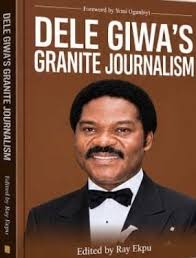
On Monday, October 19, 2026, journalists, media executives, writers, family members and admirers gathered at the Sir Kessington Adebutu Auditorium of the Nigerian Institute of Journalism (NIJ), Ogba, Lagos, to unveil Dele Giwa’s Granite Journalism, a book dedicated to preserving his writings and celebrating his enduring influence.
It was a day of reflection and remembrance, reopening not just an old wound but also prompting a reappraisal of the dangers journalists face as they carry out their professional duties with a sense of patriotism.
The occasion brought together some of the most prominent figures in Nigerian journalism, including Sam Amuka-Pemu, publisher of Vanguard Newspapers; Ray Ekpu, Giwa’s friend and former colleague at Newswatch; former Ogun State governor Segun Osoba; Dr Yemi Ogunbiyi; Nduka Obaigbena, publisher of THISDAY; Chuka Momoh; Biodun Shobanjo; and Simon Kolawole, founder and editor-in-chief of TheCable, who reviewed the book.
Giwa’s widow, Funmi, and daughter, Aisha, who was barely a year old when he died, were also present, lending a personal dimension to an occasion that combined professional tributes with reflections on the dangers journalists face in the pursuit of truth.

Edited by Ekpu, with a foreword by Ogunbiyi, the book brings together Giwa’s articles, interviews and tributes from colleagues and contemporaries. More than a memorial, it seeks to restore attention to the journalist behind the tragedy: his literary craftsmanship, intellectual curiosity, professional convictions and contributions to the development of investigative journalism in Nigeria.
The speeches moved between professional admiration, painful recollections of Giwa’s final hours and renewed concerns about the safety of journalists. At the centre of the occasion, however, was the book itself and what its pages reveal about a journalist whose writing continues to command attention four decades after his death.
Sam Amuka-Pemu, who chaired the occasion, described Giwa as a legend and a patriotic Nigerian whose contributions to journalism continue to resonate decades after his death.
He also described Giwa as a journalist who spoke truth to power and possessed a razor-sharp pen, a fierce intellect and exceptional writing ability. He questioned whether Giwa could truly be said to have disappeared when his colleagues and admirers were still gathering to celebrate his work 40 years after his death.
For Amuka, Giwa’s legacy lies not only in his accomplishments but also in the convictions that informed his journalism. Recalling his popular expression, “Protest pays,” the veteran publisher noted that the statement reflected a belief in the importance of speaking out against injustice and challenging the status quo.
Although Giwa died at 39, Amuka observed, his influence had outlived him. His writings, professional courage and commitment to public affairs remain reference points for journalists and others interested in the power of the press.
He urged Nigerians to acquire and read Dele Giwa’s Granite Journalism, describing it as a worthwhile contribution to the preservation of the country’s journalistic heritage.
His tribute was particularly significant given his own place in Nigerian media history. As the founder and publisher of Vanguard, Amuka belongs to the generation of journalists who witnessed the evolution of the Nigerian press and understood the personal and professional costs of challenging authority.

For Ekpu, the unveiling was an opportunity to redirect attention from the circumstances of Giwa’s death to the remarkable body of work he left behind.
Four decades after the assassination, the mystery surrounding it continues to occupy public consciousness. Yet Ekpu believes that Giwa’s life and journalism deserve to command equal, if not greater, attention.
“This event is a memorialisation of the founding editor-in-chief of Newswatch, Dele Giwa, who was assassinated through the use of a parcel bomb sent to him on Sunday, October 19, 1986, by some evil man. That incident turned our day into night and threw us into the abyss of grief.
“So today, we are not here to mourn the death of Dele, even though his death haunts us like an inscrutable mystery. We have done a lot of mourning, publicly and privately, in the last 40 years,” he said, adding that the gathering had a different purpose.
“We are here to give presence to his absence by presenting to the public a book that will immortalise him.”
The collection, Ekpu explained, allows readers to encounter Giwa through his own words rather than solely through the tragedy that ended his life.
Recalling their friendship and the period when their families lived together in a duplex in Ikeja, Lagos, Ekpu spoke of the personal devastation caused by the assassination. He recounted how his five-year-old son, who had wanted to become a journalist like his father and Giwa, abandoned the ambition after the killing.
“A few days after Dede’s assassination, my son came to me and said, ‘Daddy, I have changed my mind.’ “I asked him, ‘Change your mind about what?’ “He said, ‘I don’t want to be a journalist anymore.’ “I asked him, ‘Why?’ “And he said, ‘I don’t want to be killed like Uncle Dele,’” Ekpu recalled.
The anecdote drew laughter from the audience, but beneath the humour lay a sobering reminder of how Giwa’s killing affected not just his family and colleagues but also a younger generation that had begun to see journalism as a dangerous profession.
Ekpu also lamented the inadequate protection afforded media practitioners and the failure to hold perpetrators of attacks against journalists accountable.
Citing figures from the International Federation of Journalists, he said 128 journalists and media workers were killed worldwide in 2025.
“But the greater tragedy is that there is no serious effort by appropriate authorities to reverse the situation. Whoever said that, quote, ‘the pen is mightier than the sword’, did not have Nigeria in mind,” Ekpu maintained.
He urged journalists not to abandon their responsibility to society, insisting that the imperative to pursue truth and hold those in power accountable remained as important as ever.

One of the most poignant recollections at the event came from Segun Osoba, former Ogun State governor and veteran journalist who once served as managing director of Daily Times.
Osoba recalled that Giwa had expressed fears for his safety at an event on Victoria Island, Lagos, a day before his assassination. According to him, Giwa complained that security personnel were after his life.
An urgent meeting was subsequently arranged between journalists and Augustus Aikhomu, then Chief of General Staff, who reportedly promised to investigate the matter. The following day, Giwa was killed by a parcel bomb delivered to his residence.
Osoba commended Giwa’s courage and patriotism, recalling a journalist who remained committed to his profession despite concerns about his safety.
Ogunbiyi, a former managing director of Daily Times, offered a more intimate recollection of Giwa, whom he first met in 1975.
He recalled an occasion when Giwa took him to hospital after he became seriously ill and signed as his brother to facilitate emergency surgery. The anecdote revealed the compassionate side of a man often remembered for his combative journalism.
“If Dele was alive today, he and I would be getting ready for our 80th birthdays next year,” Ogunbiyi said wistfully.
He spoke of Giwa not merely as a distinguished journalist but as a friend whose memory would remain with him for the rest of his life.
“And so, when people talk of Dele Giwa as a journalist, I appreciate that, but I talk of him as a very personal friend of mine. I will never, never forget his memory as long as I live,” he said.
Ogunbiyi also urged that the book be made available to journalism schools across Nigeria so that younger generations could study Giwa’s work and learn from his craft.

For Shobanjo, founder of Insight Communications and chairman of Troyka Holdings, the anniversary was deeply personal. He recalled being among the few people present when Giwa died at First Foundation Hospital in Lagos on October 19, 1986.
Shobanjo said he was at home, living almost diagonally opposite the hospital, when the hospital’s owner, the late Dr Tosin Ajayi, called and asked him to come over. On arriving, he encountered Giwa’s wife, Funmi, whose hand was stained with blood. Ajayi subsequently led him to where medical personnel were attending to the injured journalist.
“I was the only one who was there when Dele breathed his last,” Shobanjo recalled, describing an experience that has remained with him for 40 years. He said he initially struggled to understand what was happening as he repeatedly asked Ajayi what was wrong.
For Shobanjo, Giwa was much more than a celebrated journalist. He was a close friend and a man whose personality left an indelible impression on those around him. “Today is not a day for mourning. It is a day of celebrating a great man, Dele Giwa, who was my very good friend,” he said.
“For me, Dele can never die. I mean, he was an enigma; he was larger than life. He was a journalist personified,” he added.
Shobanjo urged Nigerians to take pride in Giwa’s life and remember him as a friend, husband, father, colleague and outstanding journalist. His recollection offered a chilling personal account of the human cost of the bombing, moving the conversation beyond Giwa’s professional achievements to the life that was abruptly cut short.

Nduka Obaigbena, Chairman and Editor-in-Chief of THISDAY Media Group and ARISE News, also reflected on Giwa’s enduring place in Nigerian journalism.
Obaigbena recalled the events surrounding the journalist’s final hours, including a gathering on October 18, 1986, the day before the fatal bombing.
According to him, Giwa and other journalists had attended a lunch hosted by Kehinde Adeosun on Victoria Island. The gathering later led to a meeting with Augustus Aikhomu, then Chief of General Staff, after Giwa reportedly expressed fears that people in the security services were after him.
The following day, a parcel bomb delivered to Giwa’s residence on Talabi Street, Ikeja, exploded, killing him at the age of 39.
Obaigbena, who was a young man when Giwa was killed, recalled hearing about the bombing while playing football at the University of Lagos. He said he rushed to First Foundation Hospital, where he saw the devastating consequences of the attack.
“I rushed to First Foundation Hospital, and we saw him there, his legs cut off,” Obaigbena recalled. According to him, Tony Momoh, then Minister of Information, later arrived at the hospital, after which those present went to the Newswatch office.
Obaigbena also recalled Giwa’s burial, when Sam Amuka-Pemu, publisher of Vanguard Newspapers, reflected on the significance of journalism in Nigeria.
According to Obaigbena, Amuka said, “Journalism is a constitution of Nigeria. And you can kill it, but it won’t die.”
Obaigbena commended the veterans who gathered to honour Giwa, particularly Ray Ekpu, Soji Akinrinade and Igiebor, whose careers and contributions have been closely associated with the development of Nigerian journalism.

For Nosa Igiebor, a former Newswatch journalist and co-founder of Tell magazine, the memory of Giwa’s assassination remains inseparable from the shock and disbelief that swept through the newsroom.
Igiebor recalled that he was at the office preparing for a 1 p.m. editorial meeting when Kayode Soyinka contacted him with the news of the bombing. The report was devastating. Giwa was not simply a colleague whose death had been announced; he was a journalist whose work and professional courage had helped shape the identity of Newswatch and the ambitions of a generation of Nigerian reporters.
Igiebor questioned the brutality of the attack, asking how anyone could subject another human being to such violence because of what the person had written.
His recollection brought the conversation back to the danger journalists face when their work challenges powerful interests. It also highlighted the personal cost of an assassination that deprived the profession of one of its most influential voices.
Yet Igiebor insisted that Giwa’s story could not be reduced to the circumstances of his death. “Dele Giwa is not dead. He lives in and has left a great legacy,” he said.

In his speech, Dokun Adedeji, who was the doctor on duty at First Foundation Medical Centre, Opebi, Ikeja, when Giwa was rushed in after the explosion, gave an account of the journalist’s final moments and why he kept his clothes soaked with Giwa’s blood for five years. According to him, what he saw in the emergency room was unlike anything he had encountered in his medical practice.
“He was shattered. His two limbs were open, and he was bleeding,” he recalled.
Yet Giwa remained conscious. “Dokun, se mi o ni ku sha?” he asked in Yoruba. “I said, ‘I don’t know,’” Adedeji recounted. Barely 30 minutes after arriving at the hospital, the 39-year-old journalist was dead.
Giwa’s blood had stained Adedeji’s clothes and shoes. Unable to part with them, the doctor hung them in a corner of his room for five years. “So that every time I saw them, I would remember,” he said. “Uncle Dele was not just my patient. He was like a brother.”
Even in his final moments, Giwa kept asking about his wife, Funmi, and his youngest daughter, Aisha. “How is Aisha? Do you know anything about Aisha?” he asked.
Professor Ralph Akinfeleye, emeritus professor of mass communication at the University of Lagos, placed Giwa’s contribution within the broader ethical responsibilities of the profession.
He described Giwa’s approach as “Journalism of Conscience”, a phrase that speaks to the responsibility of journalists to pursue truth, question authority and serve the public interest.
The tribute offered a professional framework for understanding Giwa’s legacy. His significance lay not only in his writing ability but also in the courage and sense of responsibility with which he approached public affairs.
Akinfeleye also told an anecdote about why only the services of journalists would be needed in heaven. According to him, this speaks to the relevance of journalists across borders and boundaries.
The presence of Giwa’s widow, Funmi, and daughter, Aisha, gave the anniversary a deeply personal dimension. Aisha was barely a year old when her father was killed. Her knowledge of him has therefore come largely through the stories told by her mother, the recollections of his colleagues and the writings he left behind.
At the unveiling, she expressed pride in her father’s legacy and appreciation for those who had continued to preserve his memory.
Reviewing Dele Giwa’s Granite Journalism under the title The Pen That Outlived the Bomb, Simon Kolawole, founder of TheCable, said Dele Giwa’s journalism remains relevant to contemporary Nigeria, arguing that his assassination has sometimes overshadowed the quality and significance of his work.
He also said the collection offers readers an opportunity to appreciate Giwa’s contributions beyond the circumstances of his death.
“One of the tragedies of Dele Giwa’s assassination is that the manner of his death has sometimes overshadowed the magnificence of his life,” he wrote.

He highlighted Giwa’s writings on political accountability, press freedom and professional ethics, particularly his 1979 essay arguing that journalists should scrutinise candidates’ promises and programmes rather than merely report political speeches and campaign activities.
The book contains 74 pieces by Giwa, two interviews with him and 16 tributes from journalists and writers, preserving his ideas and contributions for future generations. Kolawole acknowledged Giwa’s combative nature but praised his intellectual curiosity and commitment to public affairs, noting that his work offers enduring lessons in journalistic independence, critical thinking and professional responsibility.
Emphasising the collection’s significance, he urged readers to look beyond the tragedy of Giwa’s assassination and engage with his journalism on its own merits.
“Forty years after his assassination, the remarkable thing is not simply that Nigerians still remember his name,” he wrote, “but that his writing can still command our attention, challenge our assumptions and give us considerable reading pleasure.”
For a journalist whose life was cut short at 39, the collection offers a means of extending his influence beyond the generation that knew him personally. It also provides an opportunity for younger journalists to encounter the literary brilliance, intellectual depth and professional convictions that distinguished his work.
Forty years after a parcel bomb silenced one of Nigeria’s most distinctive journalistic voices, Dele Giwa’s writings continue to speak. And in the pages of Dele Giwa’s Granite Journalism, his colleagues have offered a reminder that while violence may end a life, it cannot necessarily extinguish the ideas, words and convictions that give that life enduring meaning.