
Ladbone at 80: The Man Who Made the Red Pencil a Measure of Excellence
By Nehru Odeh
Some journalists make their names through the stories they write, while others leave their fingerprints on the stories written by others. Some editors merely pass copy through the newsroom; others transform the newsroom into a school, a crucible where words are tested, sentences interrogated, facts scrutinised, and the pursuit of excellence elevated to an article of faith.
Oyinlade Bonuola, fondly known as Ladbone, belongs to that rare breed. A journalist of granite convictions, a stickler for grammatical precision, a fastidious craftsman of the written word and a builder of journalistic institutions, he has spent more than five decades shaping Nigerian journalism, polishing generations of reporters and editors, and insisting that a newspaper must be more than a collection of stories hurriedly assembled for the morning after.
Quiet and unassuming, with a temperament that belies the formidable standards for which he is celebrated, Bonuola is a man whose influence has travelled farther than his name. He belongs to a generation of journalists for whom the newsroom was both a workplace and a university, the sub-editor’s desk a laboratory, and the printed page a solemn covenant between the journalist and the reader. For him, journalism was never simply about putting words on paper. It was about getting the words right, establishing the facts, scrutinising the details and giving readers the dignity of being properly informed.
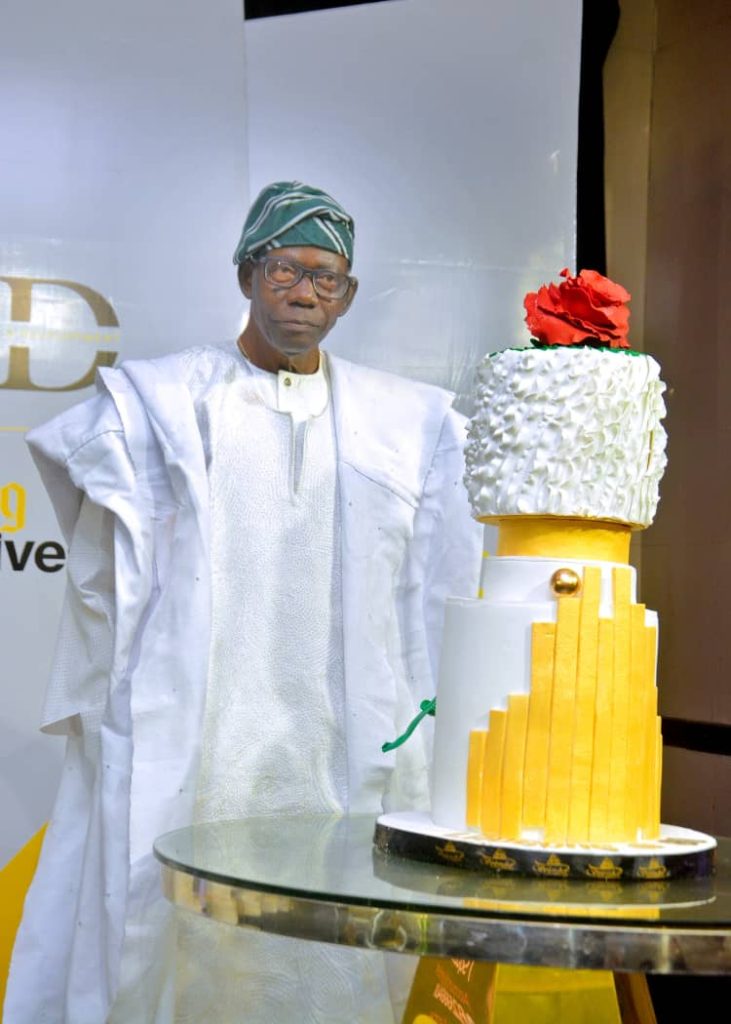
And that was why on Thursday, October 22, 2026, at the Civic Centre, Victoria Island, Lagos, the Nigerian media community gathered to celebrate this distinguished practitioner, who has an eye not just for details but also for the minutest ones, as he marked his 80th birthday. Veteran journalists, newspaper executives, editors, publishers, academics, public figures, friends, family members and professional admirers converged to pay tribute to a man whose career has become inseparable from the evolution of the Nigerian press.
But the occasion was more than a birthday celebration. It was an encounter between a remarkable life and the memories it had deposited in other lives. It was an opportunity for colleagues to revisit newsroom battles, remember the demanding discipline of the old newspaper houses, and celebrate a man whose red pencil could be as feared as it was respected.

The celebration also witnessed the unveiling of Ladbone: A Life in Print, a substantial collection of essays edited by Dapo Olorunyomi, publisher of PREMIUM TIMES and chief executive officer of the Centre for Journalism Innovation and Development (CJID). The launch coincided with the unveiling of the CJID’s Living Archives Initiative, a project designed to document, digitise and preserve the works and experiences of people whose contributions have shaped journalism and public life in Africa.
Together, the birthday celebration, the book and the initiative offered a compelling reminder that a nation’s journalistic history is too important to be left to fading memories, scattered newspaper clippings and the occasional recollection of those who were there.
If Bonuola’s professional philosophy could be reduced to a single newsroom scene, it might well be found in the recollections of Olusegun Osoba, former governor of Ogun State, veteran journalist and chairman of the birthday celebration. Osoba knew Bonuola long before the latter became a household name among journalists. Their paths crossed at the Daily Times, where Osoba was deputy editor of the Sunday Times and Bonuola served as sub-editor.
Speaking at the event, Osoba recalled that their working relationship was not always an easy one. The two men shared a commitment to producing a good newspaper, but their responsibilities sometimes placed them on opposite sides of the production clock. Osoba was concerned about deadlines and getting the paper to the newsstands on time. Bonuola, meanwhile, wanted every story to be properly edited, every grammatical weakness corrected and every punctuation mark placed where it belonged.
He remembered how Bonuola would continue marking up copy, scrutinising clauses and correcting commas, colons and semicolons, even when production deadlines were approaching. Their encounters, Osoba recalled, could become heated. He wanted the newspaper out; Bonuola wanted the copy right. “And every Saturday, it was always war… It would get to the point that I would even want to slap him. Slap him into submission. And not even then, he would continue to just edit, edit,” Osoba recalled.
Osoba described him as a serious-minded intellectual whose meticulousness helped raise editorial standards. “I know that he’s a very serious-minded intellectual. When you see people who are members of the Grail Movement, then you know you are meeting serious-minded intellectuals, because the Grail Movement is a serious intellectual institution,” he said.

He also recalled recommending Bonuola to Alex Ibru when The Guardian was being established and its publisher wanted an editor capable of building a serious newspaper. According to Osoba, he told Ibru that Bonuola was the right person for the job. It was a recommendation that helped shape the history of Nigerian journalism. Bonuola went on to establish standards that other newspapers would study and, in different ways, seek to emulate.
“And I said, look, if you want a good editor who will do a good job for a new newspaper, we always wanted a serious-minded newspaper patterned along the London. I said, well, the best editor would be Ladbone. I then recommended Ladbone to be the first editor of The Guardian. He made a very good job of it. And he created a standard that others started following,” Osoba maintained.
Femi Kusa, Bonuola’s friend and colleague from the Daily Times and The Guardian years, offered another perspective on the editor’s demanding professional ethos. For Kusa, Bonuola’s greatness lay not simply in his command of English or his capacity to identify errors. It lay in his ability to recognise what a story lacked and his determination to make it better.
He recalled how Bonuola could take a reporter’s copy and rewrite substantial portions of it, demanding more information, clearer explanations and stronger background. An inadequate report was not something to be passed along in the hope that the reader would somehow make sense of it. It had to be rebuilt.

At The Guardian, Kusa and his colleagues worked to establish a culture in which stories were properly contextualised and written with clarity and depth. They wanted news reports to do more than announce events; they wanted them to explain those events and their significance.
Kusa’s recollections also illuminated the collaborative nature of Bonuola’s achievement. Although the editor became an enduring symbol of the newspaper’s standards, those standards were sustained by the efforts of a team of journalists who shared a belief in quality journalism. Among those who contributed to that culture were Nduka Irabor and Emeka Izeze, whose work helped strengthen the newspaper’s writing and editorial processes.
The story of Bonuola, therefore, is not simply the story of an individual editor. It is also the story of an institutional culture built around professional discipline, collective responsibility and the conviction that readers deserve the best journalism a newsroom can produce.
For Dapo Olorunyomi, the celebration of Bonuola was an opportunity to honour a veteran journalist while confronting a larger problem facing Nigerian journalism: the vulnerability of its institutional memory.
Introducing Ladbone: A Life in Print, Olorunyomi described Bonuola as one of the most consequential editors in the history of Nigerian print journalism. The veteran journalist, he said, belonged to a generation whose work had left a deep imprint on the profession.
The book, which runs to about 750 pages, brings together contributions from more than 60 writers, including journalists, editors, academics, political figures, family members, friends and mentees. Their essays explore different dimensions of Bonuola’s life, from his editorial accomplishments and professional courage to his mentorship, relationships and experiences beyond the newsroom.
Olorunyomi explained that Bonuola was selected as the first subject of CJID’s Living Archives Initiative because he remains an active veteran whose career offers valuable lessons for younger journalists. The initiative seeks to preserve the works, records and experiences of people who have shaped journalism and public life across Africa. Newspaper archives, photographs, personal papers, recordings and eyewitness accounts often become scattered, inaccessible or lost with time.
By digitising and organising these materials, the project hopes to make them available to researchers, students, journalists and future generations.
In this respect, the choice of Bonuola was particularly fitting. Here was a journalist who had spent a lifetime insisting on the importance of the printed record, now becoming the subject of an effort to preserve that record for posterity.

Olorunyomi’s tribute also carried the warmth of a personal relationship. He praised Bonuola’s professional excellence, work ethic and enduring contribution to the craft, describing him as a journalist whose example continued to matter in a changing media environment.
According to him, the book was not intended merely to celebrate an octogenarian. It was an attempt to capture a tradition of journalism and make its lessons available to people who had never worked under Bonuola’s demanding gaze.
Reviewing the book at the event, Kunle Ajibade, a journalist, author and executive director of TheNews and PMNEWS, approached Bonuola’s life as both a professional biography and a window into the history of Nigerian journalism.
For Ajibade, Ladbone: A Life in Print is inspiring and enlightening, a celebration of values that remain essential to excellent public service. He observed that the collection does more than recount the achievements of its central figure.
As contributors describe their encounters with Bonuola, they also reveal something of their own professional journeys and the newsroom cultures in which they developed.
The result is a set of narratives within narratives. The life of one journalist becomes a way of understanding the lives of others, while their shared experiences illuminate the evolution of the Nigerian press.
Ajibade’s review traced Bonuola’s journey from his early years in Kishi through his education, teaching career and entry into journalism. He highlighted the veteran journalist’s intellectual curiosity, his love of reading and debate, and his rise through the ranks at the Daily Times before his long association with The Guardian.
He also drew attention to Bonuola’s interest in international journalism, particularly the media in the United States and the United Kingdom, and his admiration for accomplished journalists, including Christiane Amanpour.
Ajibade also highlighted Bonuola’s commitment to truth, discipline and editorial independence. The veteran journalist believed newspapers should be readable, inventive and truthful, and he took seriously the responsibility of maintaining the standards on which public confidence in the press depends.

The review presented Bonuola as a mentor and institution-builder whose influence extended beyond the stories he edited. His legacy was visible in the journalists he trained, the standards he established and the professional habits he passed on to others.
In paying tribute to Bonuola, Ajibade also underscored the historical value of the book. Its collection of personal recollections offers researchers and students access to the experiences of people who witnessed important moments in the development of Nigerian journalism. The book, in other words, is both a tribute and a record. It celebrates a life even as it documents an era.
For all the tributes to Bonuola’s professional rigour, the celebration also sought to illuminate the man behind the formidable editorial reputation. The contributions to Ladbone: A Life in Print explore his relationships with family, friends and colleagues, revealing dimensions of his character that the familiar newsroom stories do not always capture.
His professional life was shaped by mentors who recognised his potential and colleagues who challenged, supported and encouraged him. At the celebration, Bonuola himself acknowledged the people who helped mould his career, paying particular tribute to Babatunde Jose, Osoba, Sam Amuka and the late Alex Ibru.
He spoke appreciatively of Jose, who gave him an opportunity at the Daily Times and helped him develop his professional skills. He acknowledged Osoba’s confidence in him, Kusa’s support and Ibru’s trust in his editorial judgment.
Recalling his relationship with Ibru, Bonuola described a publisher who largely left editorial decisions to the professionals he had hired. Ibru, he said, treated him as the expert in journalism while he concentrated on the business side of the enterprise.
He also expressed gratitude to Olorunyomi for organising the celebration, praising his dedication and application to work. He disclosed that he reads PREMIUM TIMES daily, a remark that revealed a veteran journalist still engaged with the contemporary media landscape.

The celebration also opened a window onto the challenges confronting contemporary journalism. A panel discussion featuring media entrepreneur Kadaria Ahmed, Ifeanyi Mbanefo and Chiamaka Ozurumba, moderated by Azu Ishiekwene, examined the future of Nigerian journalism and the changes transforming the production and distribution of news.
The participants recognised that the practices of Bonuola’s generation cannot be reproduced wholesale in an environment shaped by digital platforms, changing audience habits and new economic pressures. The speed of publication has increased, the routes through which audiences encounter news have multiplied, and traditional media organisations face growing competition for attention and revenue.
Yet technological change does not make professional values obsolete. Ahmed, founder of RadioNow 95.3 FM, stressed that media organisations must understand younger audiences, adapt to new platforms and develop sustainable revenue streams. But she also emphasised that journalism must retain its ethical foundations of truth, accountability and public service.
Mbanefo and Ozurumba similarly emphasised the importance of empowering younger journalists and creating room for new approaches to storytelling. The next generation must be able to experiment with technology and reach audiences in new ways while remaining committed to accuracy, fairness and public trust.
The discussion brought the celebration back to Bonuola’s professional legacy. His generation worked in a media environment very different from today’s, but the central questions remain familiar. Is the story accurate? Is it fair? Does it provide enough context? Does it serve the public interest? The answers matter whether a story appears on a newspaper’s front page, a website, a mobile phone or a social media feed.
Bonuola’s career offers a reminder that technology may change the means of delivering journalism, but it cannot substitute for the judgment, discipline and integrity that give journalism its value.

Another important voice at the celebration was Frank Keurhorst, consul-general of the Netherlands in Lagos, who linked Bonuola’s professional legacy to the broader importance of a free and independent press.
“Mr. Bonuola’s career is part of that history. His decades of work as a journalist and editor, his contribution to mentoring younger generations, and his contribution to remind us of the importance of his professional integrity, editorial independence, and the responsibility that comes with informing the public. It is therefore fitting that we celebrate his life and work alongside an initiative dedicated to preserving the history of journalism,” Keurhorst noted.
Keurhorst emphasised the role journalism plays in strengthening democracy and holding institutions accountable. He also commended CJID for establishing an initiative that would preserve the experiences of journalists and ensure that their contributions did not disappear from public memory.
The Netherlands, he noted, had supported CJID’s Civic Space Guard project between 2023 and 2025. The programme provided media and information literacy training to nearly 1,000 students and more than 100 teachers across Nigeria.
” By documenting the experiences, contributions, and lessons of journalists across generations, it helps ensure that this important history is not lost. It remains accessible to those who come after us. For the Netherlands, supporting press freedom and access to reliable information is an important part of our engagement in Nigeria,” Keurhorst said.
His remarks placed the celebration within a wider conversation about press freedom, democratic accountability and the need to preserve the history of journalism.

The Nigerian press has played significant roles in the country’s political development, from challenging colonial authority to confronting military rule and scrutinising civilian governments. Its history contains stories of courage and sacrifice, but also of institutional change, professional disagreements, commercial pressures and the daily work of producing credible news.
” Today is not only a celebration of one man’s life’s achievements. It’s also an opportunity to reflect on the important role journalism has played and continues to play in Nigeria. Nigeria has a rich and dynamic media landscape. Its journalists have reported during military rule, democratic transitions, and periods of significant social and political change. Throughout these periods, the press has bravely helped to inform the public, hold institutions accountable, and create space for different voices to be heard,” Keurhorst noted.
Femi Kusa, former editor and director of publications at The Guardian, described Bonuola as one of Nigeria’s finest journalists. Their relationship spanned approximately 55 years, beginning at the Daily Times in 1971. Kusa recalled that Bonuola trusted his judgment enough to ask him to preview the Caught Out column before publication. Their relationship grew into a close professional partnership, with Kusa describing Bonuola as an elder brother who offered guidance on how to succeed.
Kusa also highlighted Bonuola’s uncompromising commitment to editorial excellence. At The Guardian, he insisted that reports be properly contextualised and that inadequate stories be thoroughly revised rather than published in their original form.
In his account of the newspaper’s confrontation with the military government of General Sani Abacha, Kusa recalled Bonuola’s principled stance on editorial independence. When the government sought an apology from The Guardian, Bonuola initially refused to participate in the proposed meeting and resigned as managing director when publisher Alex Ibru insisted. Kusa also recalled their subsequent preparation for a meeting with Abacha, at which the newspaper’s representatives were not required to apologise.
Dipo Ajayi, a veteran journalist from the Daily Times family, recalled a deeply personal experience that revealed Bonuola’s compassion beyond the newsroom. Ajayi recounted that he was in detention when his second child was due to be born, following the assassination of General Murtala Mohammed on February 13, 1976. Concerned about his wife’s condition and the possibility of premature labour, Bonuola sent a message to Ajayi’s brother, Professor Ade Ajayi, then vice-chancellor of the University of Lagos, to ensure that his wife received the necessary attention and support. At the birthday celebration, Ajayi expressed gratitude for Bonuola’s intervention, recalling the kindness he had shown his family during that difficult period.
As the tributes gathered around Bonuola at the Civic Centre, one image seemed to bind the different recollections together: the editor at his desk, leaning over a story, pencil in hand, unwilling to let an error pass simply because the deadline was near. It is an image that invites both affection and reflection.
To some colleagues, he was the demanding editor who could make a reporter return to a story repeatedly. To others, he was the mentor who taught them to ask better questions, supply missing details and respect the reader. To the newspaper industry, he was an institution-builder who helped establish standards that outlived his years in particular newsrooms.

Bonuola’s 80th birthday was therefore both a celebration of achievement and a meditation on continuity. The journalists who gathered to honour him celebrated not only a man but also the values he represented: discipline in the newsroom, integrity in public life, independence in editorial judgment and a commitment to professional excellence.
For more than five decades, Ladbone has helped remind Nigerian journalism that the smallest details can carry the greatest responsibilities. A misplaced comma may seem trivial; a factual error may occupy only a line; an inadequately explained story may pass unnoticed amid the daily torrent of news. But taken together, such lapses can weaken the bond of trust between a newspaper and its readers.
At 80, he stands as a witness to an era, a participant in the present and a source of lessons for the future. The newspaper pages he helped shape have yellowed, newsrooms have changed, and the technologies of publication have multiplied. But the questions at the heart of his craft remain.