
NCCE charges South-East teachers training colleges on quality, dual mandate implementation
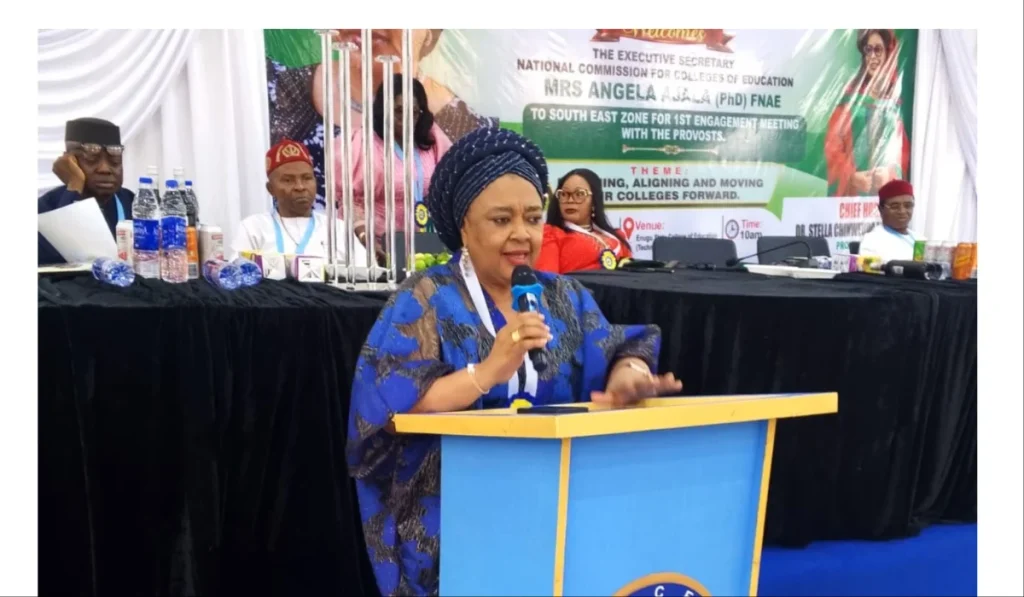
The National Commission for Colleges of Education, NCCE, has charged the government and stakeholders in the South-East to channel more efforts towards the training of quality teachers.
The Executive Secretary of the NCCE, Dr Angela Ajala, stated this during an engagement meeting with provosts of Colleges of Education in the South-East, hosted by the Enugu State College of Education (Technical), Enugu.
Ajala said whereas some zones in the country could boast of over 30 Colleges of Education, the South-East was trailing with just slightly over 10.
According to her, the engagement meeting was tailored towards improving teacher quality, skills development, digital learning and the effective implementation of the dual mandate of Colleges of Education.
While harping on increased budgetary allocation to education, the Executive Secretary said: “When you consistently recognise that a sector is important and should not be ignored, over time, people begin to believe and treat that sector with the respect it deserves.”
She, however, stressed that increased funding for infrastructure would have limited impact without corresponding investment in teacher preparation.
“Everyone of us in this room knows exactly what it means when they say a nation cannot rise above the quality of its teachers,” Ajala said, adding that “if you build 1,000 smart classrooms or smart schools” without improving the quality of teachers, “then you have done nothing.”
She urged Colleges of Education to reposition teacher training to meet the demands of modern classrooms, particularly as schools increasingly introduce artificial intelligence, mechatronics, digital technology and practical skills.
According to her, “a teacher cannot give a child a skill she does not have herself,” stressing the need for teacher-training institutions to equip students with practical, entrepreneurial and digital competencies.
Ajala said the renewed direction of teacher education would enable students to graduate with an NCE, degree, globally recognised skills certificate and professional registration.
She added that such training would provide graduates with opportunities both within and outside the teaching profession.
The NCCE boss also called for greater use of student loans to ensure that financial difficulties did not prevent young Nigerians from accessing higher education.
Earlier, the Provost of Enugu State College of Education (Technical), Dr Stella Ekwueme, said the engagement provided an opportunity for meaningful dialogue and collaboration on the development of teacher education.
Ekwueme said the demands of the contemporary classroom were changing rapidly, requiring Colleges of Education to equip teacher trainees with “the practical competencies, digital skills, professional ethics and problem-solving abilities required to function effectively in today’s educational environment.”
She called for stronger partnerships among the NCCE, state governments and Colleges of Education, particularly in infrastructure, staff development, curriculum implementation, technology, teaching resources, research and academic programmes.
On the dual mandate, the provost said it presented both “an opportunity and a responsibility” for Colleges of Education to produce competent teachers at NCE and degree levels while adapting to the changing higher education environment.
She expressed optimism that the engagement would produce practical outcomes, identify areas requiring intervention and strengthen continuous communication between the NCCE and Colleges of Education in the South-East.