
Obiora Udechukwu @ 80: Celebrating a Life Devoted to Art and Humanity
By Nehru Odeh
Some artists paint pictures, and others paint the world as they see it, feel it and wish it could be. Some artists’ brushes capture the beauty of life, while the lines of others become the language of protest, memory, suffering and hope. Professor Obiora Udechukwu belongs to that rare company of artists for whom art is not merely an aesthetic pursuit but a profound engagement with humanity.
A painter, draftsman, printmaker, poet, critic, teacher and scholar, Udechukwu has spent more than five decades exploring the intricate relationship between art, literature, indigenous knowledge and society. His is a creative journey in which the brush and the pen are inseparable. Through his paintings and drawings, he has given expression to the human condition, interrogating the contradictions of society while drawing generously from the cultural heritage of his people.
At 80, his life and work represent an extraordinary chapter in the history of modern and contemporary Nigerian art. He is one of the defining figures of the Nsukka School, a distinguished interpreter and transformer of the Uli artistic tradition, and one of the artists whose intellectual and creative contributions helped shape the direction of Nigerian art after independence and the Civil War.
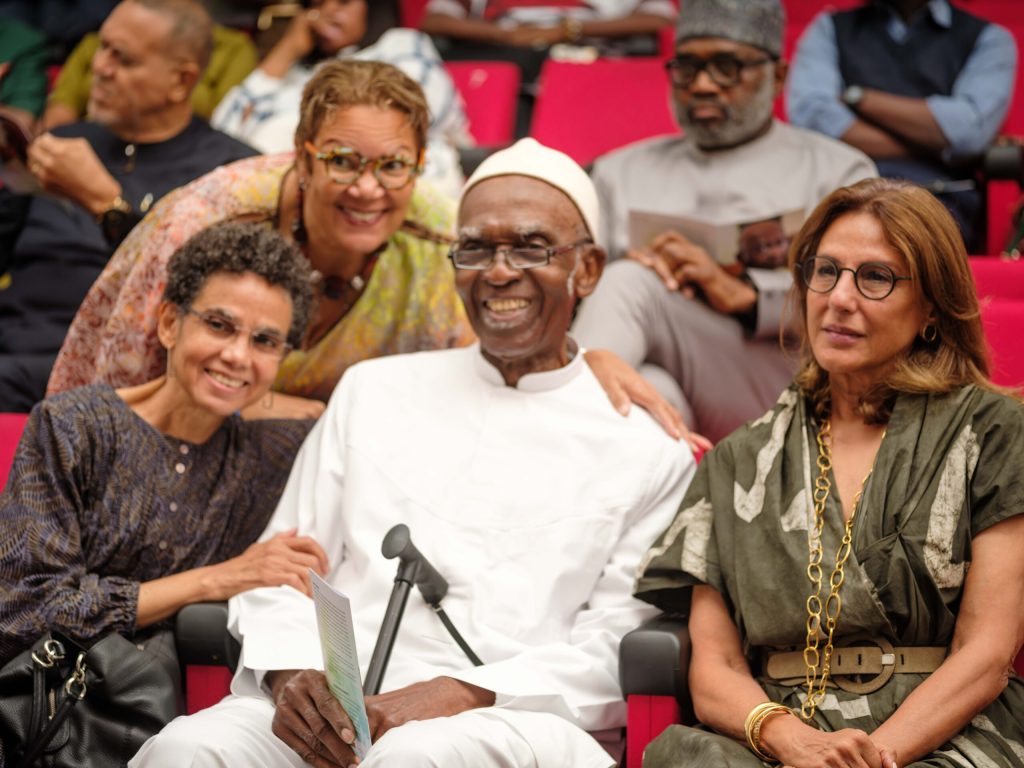
It was, therefore, fitting that artists, scholars, curators, writers, former students, admirers and members of the cultural community gathered on Saturday, November 7, 2026, at the Alliance Française/Mike Adenuga Centre, Ikoyi, Lagos, to celebrate him at a symposium and book launch titled Obiora Udechukwu @80: A Celebration and Symposium.
The gathering was not simply a birthday celebration. It was an occasion to revisit the history of an artist whose influence has travelled across generations, to examine the social and intellectual philosophy behind his work, and to recognise a lifetime devoted to the advancement of art, education and humanity.
At the heart of the celebration was the presentation of The Aka Circle and the Making of Contemporary African Art, a book by art historian and curator Iheanyi Onwuegbucha. The publication, which grew out of an exhibition devoted to the Aka Circle, offered another opportunity to examine Udechukwu’s contribution to the development of Nigerian art, particularly his role in establishing the collective alongside Ghanaian artist El Anatsui.
But before the book presentation and the discussions that followed, the celebration began with tributes to the man whose life and work had brought everyone together. However, Jahman Anikulapo, who anchored te event, spiced it up with his characteristic sense of humour.
There was also a Poetry, Spoken Word and Music session which featured Ada Udechukwu, Segun Arinze, Tony Nsofor and Goodness Nnabeze.
In her opening remarks, Kavita Chellaram, who has developed close relationships with several artists associated with the Aka Circle, including El Anatsui, Chika Okeke-Agulu and Obiora Udechukwu, described the publication as an important contribution to Nigerian art history.
She recalled how artists associated with the Nsukka School had occupied a special place in the exhibition programme of her gallery, with their works presented both in Nigeria and internationally. Among the exhibitions she highlighted was the presentation of Udechukwu’s work at Frieze Masters. She also recalled the exhibition dedicated to the Aka

“I’ve followed and admired their work for many years. And it is especially meaningful to see their contribution to Nigerian art history brought together in this publication. Aka Circle and the Making of Contemporary Art, the artists of the Nsukka School have always held a special place in our exhibition program,” she noted.
For Chellaram, that exhibition provided an opportunity to revisit the history of the group and the artistic relationships that shaped it. She was particularly pleased that the project had evolved into a lasting scholarly publication, deepening understanding of an important chapter in Nigerian modern and contemporary art. She congratulated Onwuegbucha and everyone who contributed to the book, describing its publication as an achievement worthy of celebration. “It represents a valuable contribution to the growing body of scholarly research on Nigerian modern and contemporary art, helping to deepen our understanding of an important chapter in its history,” she said.
One of the most compelling moments of the symposium was the citation on Udechukwu delivered by Professor Chris Krydz Ikwuemesi, Dean of the Faculty of Arts, University of Nigeria, Nsukka. Titled Obiora Ada Udechukwu: The Artist as Poet, the Poet as Artist, the citation explored the extraordinary relationship between the visual and literary dimensions of Udechukwu’s creative practice.
Ikwuemesi argued that while some painters occasionally write and some poets occasionally engage in visual art, Udechukwu belongs to a different category of artists for whom words and images spring from essentially the same imaginative source. His career, he said, demonstrates the intimate conversation between the visual and verbal that became an important feature of the creative culture of Nsukka.
“Here then is an artist who did not recognize the artificial world we sometimes erect between disciplines. For him, painting could think, drawing could speak, poetry could become visual, and indigenous knowledge could nourish modern practice without becoming a prison for it. The visual-verbal traffic also characterizes much of what became known as the Nsukka school,” Ikuemesi maintained.
Born in 1946, Udechukwu studied briefly at Ahmadu Bello University, Zaria, before completing his BA in Painting at the University of Nigeria in 1972 and his MFA in 1977. Even his academic research revealed his enduring interest in indigenous artistic traditions, folklore and the relationship between art and literature.
Ikwuemesi traced this relationship through Udechukwu’s artistic and literary accomplishments. His poetry appeared in journals and anthologies from the late 1960s, while his collection, What the Madman Said, published in 1990, won the ANA/Cadbury Poetry Prize and contained his drawings. His 1975 series of ink drawings, Homage to Christopher Okigbo, his 1990 lecture, The Artist as Poet, The Poet as Artist, and his solo exhibition, Of Images and Words, in 2000, further demonstrated his conviction that neither painting nor poetry should be confined to artificial disciplinary boundaries. His involvement with Chinua Achebe’s Okike, where he served as managing editor from 1985 to 1997, and his contributions to the Association of Nigerian Authors also reflected his commitment to literary and intellectual life.
But Ikwuemesi’s tribute was not merely an academic assessment. It was deeply personal. He recalled that his relationship with Udechukwu began long before the latter formally became his teacher. As an undergraduate in 1992, he had written his BA thesis on Uli as a creative idiom, studying the works of Udechukwu, Anyako and Dorothea. He subsequently became Udechukwu’s MFA student and supervisor. He also recalled the difficult period of 1996 and 1997, when the university crisis following the Academic Staff Union of Universities strike resulted in the dismissal of several academics, including Udechukwu, Chika Okeke-Agulu and himself. When Udechukwu eventually left Nigeria for an appointment at St Lawrence University in the United States, Ikwuemesi lost his MFA supervisor and felt, in his words, like an orphaned child.

Yet the teacher’s influence endured. Years later, as Dean of the Faculty of Arts, University of Nigeria, Nsukka, he found himself honouring the same teacher who had helped shape his intellectual and artistic journey. For him, Udechukwu’s greatest lesson was that cultural inheritance should be a point of departure, not confinement.
The intergenerational panel discussion, titled Paintings at Nsukka: Generations, Practices and Legacies, provided perhaps the most illuminating demonstration of how far Udechukwu’s influence had travelled. Moderated by Iheanyi Onwuegbucha, the discussion brought together artists from different generations and backgrounds whose creative journeys had intersected with the Nsukka School. They included Liz Perry, Professor Chika Okeke-Agulu, Dr Sukanthy Visagapperumal Egharevba, Nkechi Nwosu-Igbo and Obinna Makata.
The panel was particularly significant because it brought together artists who encountered Udechukwu at different stages of their development. Some studied under him in the 1980s, others in the 1990s, while one belonged to the last generation of students he taught before leaving Nigeria. Makata, on the other hand, encountered his intellectual and artistic legacy through subsequent generations of teachers. Their experiences offered a fascinating picture of how the philosophy of the Nsukka School has continued to evolve.
For Liz Perry, an artist from England who travelled to Nigeria to undertake an MFA at the University of Nigeria, Nsukka, the journey was an unexpected encounter with an artistic tradition that would transform her practice.
She recalled that after completing her undergraduate studies, she became dissatisfied with the limitations of the figurative painting tradition in which she had been trained. She travelled to the United States to study the works of abstract expressionists, including Jackson Pollock and Willem de Kooning, hoping to discover a new artistic direction. But it was an encounter with West African art at the Metropolitan Museum of Art in New York that proved more decisive. She was particularly fascinated by the Igbo-Ukwu bronzes and subsequently applied for a Commonwealth scholarship to study at Nsukka.
Perry said she initially knew little about the Zaria School or Uche Okeke’s philosophy of natural synthesis. She had come primarily to study the traditional art forms of the region. What she encountered, however, was a vibrant art department where Udechukwu was leading a painting tradition that brought indigenous aesthetics into conversation with modernist abstraction. While Uche Okeke encouraged her to develop a lexicon of Uli motifs, Udechukwu pushed her beyond the mere identification of symbols.
He helped her understand that Uli was not simply a collection of motifs but an aesthetic philosophy that could inspire individual artistic expression. Through his encouragement, she also began to explore other traditions, including Chinese calligraphy and Nsibidi. Her experience at Nsukka, she explained, broadened her understanding of painting and dismantled the rigid boundaries between artistic disciplines.
Professor Chika Okeke-Agulu, an art historian, curator and artist, offered a revealing account of his early encounters with the Nsukka School and the influence of Udechukwu on his artistic development. He recalled arriving at the University of Nigeria in August 1985 with virtually no formal exposure to the world of professional art. Having never attended an art school or encountered many practising artists, he described his experience as learning almost from kindergarten. He found himself among highly competitive classmates, some of whom already possessed considerable artistic sophistication. “I think It was an incredibly competitive group of students. And I was coming from nowhere,” he recalled.
The experience was intimidating, but he chose to persevere. He initially studied sculpture before moving into painting for his MFA, a decision he attributed largely to his desire to learn from Udechukwu and El Anatsui. Their artistic practices became important reference points in his development.
For Okeke-Agulu, one of the most enduring lessons of the Nsukka School was the relationship between aesthetics and social responsibility. He argued that it was almost impossible to study at Nsukka, particularly in the humanities and Fine Arts Department, without becoming conscious of art as politics by other means. He was particularly influenced by Udechukwu’s ability to combine the beauty and eloquence of line with a profound engagement with the human condition.

Drawing from the Igbo understanding of mma, which connects beauty with goodness, he explained that Udechukwu’s artistic philosophy demonstrated that beauty should not be separated from ethical responsibility. His own commitment to using art as a tool for social criticism, therefore, grew partly out of the intellectual environment he encountered at Nsukka and the example of his former teacher.
For Sukanthy Visagapperumal Egharevba, a lecturer and practising artist at the University of Cross River State, Calabar, her encounter with Nsukka was shaped by displacement, cultural adaptation and the discovery of artistic connections between two different societies.
She explained that she never planned to come to Nigeria. The civil war in Sri Lanka brought her family to Benue State, where her father was working at the time. Eventually, the family decided that she would continue her education in Nigeria, and Nsukka became her preferred destination because she wanted to study art.
However, adjusting to the university was difficult. English was her second language, having received her earlier education in her mother tongue. She described the experience as a double displacement. Fortunately, Professor Anyako and Udechukwu offered guidance and encouragement. Udechukwu, who was both her painting lecturer and academic adviser, understood her difficulties and helped her find confidence in the classroom.
Her artistic practice eventually evolved into a synthesis of Tamil artistic traditions, Uli and the visual elements of Tiv art. She explained that she had been exposed to Kolam, a traditional floor-decoration practice of Tamil people in Sri Lanka and South India, which uses dots and lines. She subsequently recognised similarities between its visual language and Uli, particularly their use of lines and patterns. Her experience in Benue also introduced her to Tiv artistic elements. Over time, these influences became integrated into her paintings. She said Udechukwu taught her that an artist must be a thinker and that a line should be more than a mark on a surface; it could become a dialogue. The experience at Nsukka gave her the intellectual foundation to borrow from different cultural traditions without losing her identity.
Nkechi Nwosu-Igbo, who belonged to the last set of students Udechukwu taught at Nsukka before his departure for the United States, offered a particularly intimate account of her relationship with the artist.
Unlike some of the other panellists, her acquaintance with Udechukwu began in childhood. She recalled meeting him when she was about four years old because he was a close friend of her father and a friend of her cousin, Chukwu Mazuni. Her childhood home was a gathering place for artists, poets and intellectuals, and she grew up listening to their conversations. Her father, she said, even covered Udechukwu’s wedding, and she still possesses cartons of photographs from the occasion. By the time she decided to study art at Nsukka, Udechukwu was already a familiar and almost fatherly figure. Her father had asked whether she was going to become another Obiora Udechukwu because she wrote extensively and translated her poems into drawings.
She recalled that the difficult university atmosphere of 1996 and 1997 meant that Udechukwu was not always available to teach. But rather than allow the situation to interrupt their development, he gave the students numerous assignments and introduced them to a rigorous culture of artistic criticism. Every Thursday, they mounted exhibitions of their works and discussed them collectively. They were expected to defend their artistic decisions, assess their colleagues’ works and engage critically with the ideas behind the images.
Although the process was initially intimidating, she later realised how much it had helped them mature. Her artistic practice has since evolved, with some of the Uli motifs and symbols that characterised her early works gradually disappearing. Yet she acknowledged that the influence of her Nsukka education remained embedded in her creative thinking, particularly in her continuing interest in female voices, young girls and the ways their experiences are represented.
Obinna Makata represented a generation that did not have the opportunity to study under Udechukwu but inherited his artistic philosophy through the teachers and intellectual traditions he left behind.
He described Udechukwu as his grand teacher, having studied under artists who were themselves influenced by the professor, including Chris Krydz Ikwuemesi and Chika Okeke-Agulu. Makata’s own artistic journey began in childhood. At about 12 or 13, he won a national painting and drawing competition, an achievement that encouraged a local carver to invite him to train in his studio. From then on, his life revolved around art. He recalled moving between school, home and the studio, developing skills in carving, painting, casting and other forms of artistic expression. By the time he completed secondary school, he was already taking commissions. He arrived at university convinced of his abilities, eager to demonstrate his drawing skills to his classmates.
But his first drawing class proved a turning point. Rather than being encouraged to produce realistic pictures, he and his classmates were instructed to draw lines repeatedly. Initially disappointed, he eventually discovered that the exercise was opening up new possibilities. He began to recognise forms, dimensions and unexpected visual expressions within the lines. His subsequent discovery of a catalogue of an exhibition titled Poetics of Lines in the departmental library further transformed his understanding of drawing. He began to study Udechukwu’s works and recognised that drawing could stand independently as a finished artistic expression rather than merely serve as preparation for painting or sculpture.
This discovery became particularly important after graduation, when financial constraints made it difficult for him to afford sculptural materials. He began experimenting with biro and paper, eventually incorporating other materials into his practice. Today, his large-scale drawings and experiments with bones, sticks and found objects demonstrate how the language of the line continues to evolve beyond the traditional canvas.
Beyond the panel discussion, the centrepiece of the celebration was the presentation of Iheanyi Onwuegbucha’s book, The Aka Circle and the Making of Contemporary African Art. In his lecture, titled The Aka Circle and the Nigerian Project, the art historian explored the relationship between the emergence of the collective and the political, economic and social realities of Nigeria.
Onwuegbucha explained that the book began as a modest catalogue for his 2024 exhibition, Cremated Spirits: A Gathering of the Aka Circle of Exhibiting Artists. The exhibition had been organised at the request of Udechukwu and El Anatsui to celebrate the latter’s 80th birthday. However, his curatorial research, combined with his doctoral research on the Nsukka School, convinced him that the history of the Aka Circle deserved a much more comprehensive treatment. What was initially conceived as an exhibition catalogue consequently evolved into a full-length publication.
He identified two major contributions of the Aka Circle to contemporary Nigerian and African art: its members’ sustained experimentation with conventional and unconventional materials, and their engagement with the social and political conditions of postcolonial Nigeria. He argued that the group’s importance went beyond artistic innovation. Its exhibitions provided a platform through which artists could interrogate the failures of the Nigerian state, political repression, economic hardship, displacement and social inequality. In his view, the collective became one of the important artistic formations whose works consistently documented the turbulent final decades of the 20th century.
Tracing the origins of the group, Onwuegbucha recalled that Udechukwu and El Anatsui established the Aka Circle in 1985 after recognising the need for a professional association that could support artists in eastern Nigeria and organise regular exhibitions, particularly in Lagos. Drawing from their earlier experiences with the Odunke community of artists and the Society of Nigerian Art, as well as Anatsui’s participation in artistic collectives in Ghana, they envisioned a group that would encourage collaboration without sacrificing individual expression. They subsequently reached out to 11 other artists, including Chika Anyako, Tayo Adenaike, Chris Afuba, Ogyora Anidi, Ifediora Magike, Chike Ebebe, Chris Echeta, Nseka Esen, Bona Ezudu, Boniface Okafor and Samson Uchendo. Chika Okeke-Agulu and Tony Umunna later joined the group.
One of the most engaging aspects of Onwuegbucha’s lecture was his examination of how Aka artists responded to Nigeria’s political and economic crises through their works.
He situated the emergence of the collective within the wider post-independence African struggle to define modernity, cultural identity and creative expression outside colonial frameworks. But the optimism that accompanied independence soon gave way to military coups, civil wars, economic hardship and political repression. In Nigeria, these developments were particularly pronounced, from the Civil War and the oil boom to the collapse of the economy, the Structural Adjustment Programme and the prolonged struggle to restore democratic government.
According to him, these realities provided the historical context for the emergence of the Aka Circle. Its artists became cultural witnesses, documenting the contradictions of the Nigerian project through paintings, drawings, sculptures and installations. Their works explored hunger, displacement, moral decay, political uncertainty and the anxieties of a society struggling to define its future.
He cited El Anatsui’s They Made It Happen, Watched It Happen, But Now Wonder What Happened, exhibited in 1986, as an example of the group’s early political commentary. The sculpture, carved from a single piece of wood, depicted a hand nervously clasping a coin, which Onwuegbucha interpreted as a possible response to the massive devaluation of the naira under the Structural Adjustment Programme.
He also discussed Chika Anyako’s National Mirage, which interrogated the uncertainty surrounding General Ibrahim Babangida’s transition programme; Nseka Esen’s Graffiti, from See No Evil, Hear No Evil, Speak No Evil Anymore, which challenged the culture of silence under military rule; and Chris Echeta’s New Breed Politicians, which reflected public suspicion of the emerging political class.
The annulment of the June 12, 1993 presidential election also found expression in the group’s artistic output. Samson Uchendo’s What the Boxes Said on June 12, 1993, made from painted matchboxes assembled into the shape of a horse, the symbol of the Social Democratic Party, offered an ingenious commentary on the annulled election. The work’s title played on the different meanings of boxes: ballot boxes, television sets through which the annulment was announced, and the matchboxes used to construct the sculpture.
Onwuegbucha further examined Chika Okeke-Agulu’s Can You Kill the Sun?, a visual elegy for executed environmental activist Ken Saro-Wiwa. The watercolour, which presented Saro-Wiwa’s face against a dark blue background overlaid with fragments of text, reflected the brutality of the Abacha regime and the struggle of the Ogoni people against environmental devastation and political marginalisation.
Other works examined included Chris Echeta’s May 29, 1999: Handover, which reflected the return to civilian rule, and El Anatsui’s Visa Queue, which explored immigration, frustration and the growing desire among Africans to seek opportunities outside the continent.
For Onwuegbucha, these works demonstrated that the Aka artists did not regard artistic expression as separate from social responsibility. Their different biographies and experiences informed their responses to the society around them, but they shared an intellectual commitment to interrogating the human condition. Udechukwu’s empathy for the vulnerable, for instance, was partly rooted in his experiences of hunger and deprivation during the Nigerian Civil War.
The book discussion featured Professor Jerry Buhari of Ahmadu Bello University, Zaria, and writer and critic Sabo Kpade, who offered different perspectives on the publication and its significance for Nigerian art scholarship.
Buhari described the book as a significant contribution towards the development of a comprehensive history of contemporary Nigerian art. He noted that although its title

ambitious, Onwuegbucha had successfully established the context within which the Aka Circle operated and clarified its place in the evolving history of Nigerian art. He described the collective as an artistic platform that provided opportunities for professional engagement, experimentation, fellowship and sustained reflection on the Nigerian project.
He also situated Aka within a longer tradition of artistic collectives and initiatives, including the Zaria Art Society, Mbari in Ibadan and Enugu, and the Odunke community. These earlier formations, he argued, helped establish a culture of collective artistic practice that Aka subsequently developed. He described the group as a watershed in the development of contemporary Nigerian art, particularly in eastern Nigeria, noting that subsequent initiatives such as Limca and Visual Orchestra benefited from the example it provided.
However, Buhari also raised important questions about the history and documentation of artistic collectives in Nigeria. He called for more research into the role of women, the influence of geography on cultural initiatives and the experiences of other artistic communities in places such as Auchi, Ife and Benin. He lamented the decline of field-based art scholarship, arguing that researchers must move beyond questionnaires and written accounts to visit artists’ studios, examine their working processes and engage directly with their creative environments. He ended by asking whether the Aka Circle could be revived or whether its legacy had evolved into something larger than the original collective.
For Sabo Kpade, a writer and critic, the book was a compelling account of a group of artists who used regular exhibitions as a platform for experimentation, invention and intellectual engagement.
He recalled that his first serious encounter with the Aka Circle came through the 2024 exhibition, Kindred Spirits. Although he was already familiar with the writings and scholarship of Chika Okeke-Agulu and Udechukwu, he had not previously engaged deeply with the history of the collective. Reading Onwuegbucha’s book, however, gave him a clearer understanding of how the annual exhibitions became the foundation of the group’s artistic and intellectual activities. He particularly praised the writing, describing it as possessing the fluidity and accessibility of excellent magazine writing while retaining academic rigour.
Kpade was especially interested in the idea that an exhibition could serve as a model for knowledge production. He recalled a phrase he had encountered in the writings of Olu Oguibe and Salah Hassan: “If you don’t exhibit, you don’t exist.” For him, Aka demonstrated the importance of consistent exhibitions in making artistic ideas visible and establishing a collective framework for experimentation. The group’s commitment to producing and exhibiting new works every year, he argued, encouraged its members to compete, innovate and continually expand their artistic possibilities.
He also reflected on the unequal trajectories of artists within the collective, particularly the contrast between El Anatsui’s international recognition and the comparatively limited visibility of some of his contemporaries. He raised questions about the economics of art, observing that the book said relatively little about the financial value of artworks, the cost of production and the commercial realities of artistic practice. He also wondered what happened to the intellectual energy of Aka after its exhibitions stopped in 2005. Nevertheless, he described the publication as an important model for documenting other artistic formations, including the Auchi Art School, whose history he is researching.
What emerged from the symposium was a portrait of an artist whose contribution cannot be measured solely by the paintings and drawings he has produced. Udechukwu’s influence is also evident in the generations of artists he taught, the intellectual traditions he helped establish, the collectives he nurtured and the conversations he initiated between art, literature and society.
His experience of the Nigerian Civil War, his engagement with Uli, his poetry and his commitment to social criticism all contributed to an artistic philosophy in which beauty

humanity are inseparable. He demonstrated that an artist could draw from indigenous traditions without being imprisoned by them, embrace modernist experimentation without surrendering cultural identity, and pursue aesthetic excellence without turning away from the suffering of society.
Perhaps the most touching tribute came from the former students and younger artists who spoke about the lessons they had inherited from him. Some encountered him directly in the classroom; others encountered his works through catalogues, exhibitions and the teachings of those who had studied under him. Yet their accounts revealed a common thread: Udechukwu taught them to think, to question, to experiment and to understand that artistic practice requires more than technical competence.
At 80, therefore, Professor Obiora Udechukwu stands not merely as a celebrated artist but as a teacher whose influence continues to reproduce itself through other artists, a poet whose lines have found expression in images, and a cultural thinker whose work has consistently engaged the moral and political questions of his time.
The symposium at the Alliance Française/Mike Adenuga Centre was, in that sense, more than an occasion to celebrate a remarkable birthday. It was a reminder that the true
of an artist’s life lies not only in the works left behind but also in the minds awakened, the traditions transformed and the lives touched.
And in Udechukwu’s case, the conversation between the brush and the pen, between art and humanity, is far from over.