
US grounds all flights nationwide over air traffic control communication outage
By Kazeem Ugbodaga
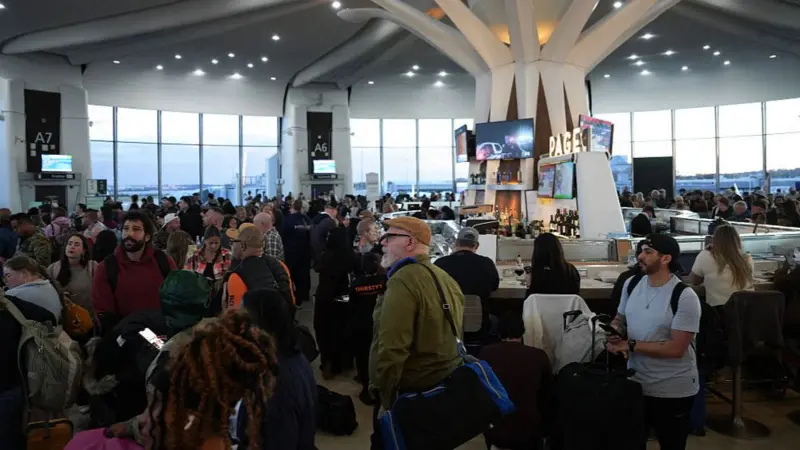
The United States has ordered a nationwide grounding of flights following a telecommunications outage affecting air traffic control centres, disrupting air travel across the country and leaving thousands of passengers stranded at airports.
The Federal Aviation Administration (FAA) announced the ground stop on Friday, citing extraordinary circumstances and safety concerns, as technicians worked to investigate the communication failure.
The disruption affected several major airports, including those in Atlanta, Washington DC, Miami, Los Angeles, New York and Houston, with passengers reporting delays, cancellations and uncertainty over their travel plans.
US Transportation Secretary Sean Duffy said the FAA had ordered the nationwide suspension of flights after a communication problem affected air traffic control centres across the country.
“FAA issued a nationwide ground stop for all US airports following a communication issue impacting all Air Route Traffic Control Centers. FAA technicians are investigating the issue. We will provide immediate updates as we have them,” Duffy said.
The FAA later confirmed that a temporary telecommunications outage was responsible for the disruption, adding that all flights had been accounted for.
“There has been a temporary telecommunications outage – out of an abundance of caution all flights have been halted,” the agency said in a statement posted on X.
It added that international flights would be handled on a case-by-case basis.
The scale of the disruption was reflected in data from flight-tracking website Flightradar24, which reported that about 3,100 aircraft were already in the air and heading towards US airports, while no additional aircraft were taking off.
Passengers aboard some arriving flights also reported being held on the tarmac, with aircraft unable to proceed to their designated gates.
In Los Angeles, a passenger told the BBC that planes which had landed were not being allowed to taxi to the gates because departing flights had also been stopped.
The disruption prompted concern among travellers, with several airports advising passengers to contact their airlines and check flight statuses before travelling to terminals.
US Homeland Security Secretary Markwayne Mullin sought to reassure the public, saying there was no indication that the incident was an attack against the country.
“This is a telecommunications outage,” Mullin said, adding that “everybody’s safe” and all flights had been accounted for.
He repeatedly dismissed comparisons with the September 11, 2001, terrorist attacks, saying: “This isn’t another 9/11. This is a telecommunication outage, this is much different.”
Mullin also said the disruption was not connected to the ongoing Microsoft outage, while acknowledging that officials did not yet know what caused the telecommunications failure or how long it would take to resolve.
Meanwhile, major airlines began announcing operational adjustments.
United Airlines said new domestic flights would not depart while the ground stop remained in force, although international departures would be managed on a case-by-case basis in consultation with the FAA.
American Airlines said flights already in the air would continue to their destinations, but warned that disruptions to its regular schedule were expected for the remainder of the day.
The airline said it was preparing to resume normal operations once the FAA lifted the nationwide restriction.
Canada’s air navigation provider, NAV CANADA, said its systems were operating normally and that the US disruption was not affecting flights within Canadian airspace. It added that it remained prepared to support aircraft diverted from US destinations.
Although the FAA confirmed that every flight had been accounted for, authorities had yet to establish the precise cause of the outage or provide a timeline for restoring normal operations.
The incident has also renewed attention on the state of America’s air traffic control infrastructure. BBC international business correspondent Theo Leggett noted that some US air traffic control systems were outdated, with certain operations still relying on technologies such as floppy disks.
Congress approved $12.5 billion last year for upgrades, while the FAA recently pledged to replace systems that still depend on floppy disks by the end of 2028.