
2027: Nigeria needs to be rescued from darkness, hopelessness – NRM
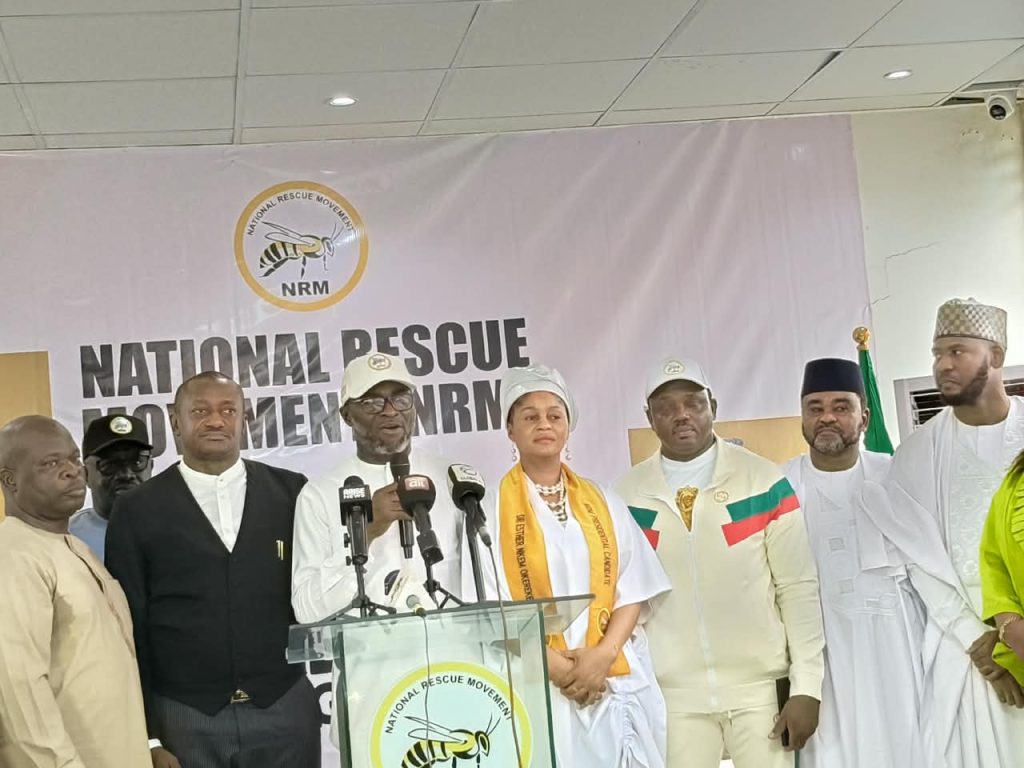
The presidential candidate of the National Rescue Mission, NRM, Esther Okereke, has called on governments and political leaders in the country to focus more on sharing prosperity instead of sharing power
Okereke made the call during the inauguration of the party’s Presidential Campaign Council, PCC, in Abuja on Tuesday, adding that leaders have focused on sharing power for too long.
She also noted that for too long, campaigns have been about noise, adding that it should rather be about structure, evidence, and peace, insisting that what the country needs at this point is not another government but to be rescued.
“Rescue from darkness, hunger, insecurity, joblessness and hopelessness,” She said.
Also speaking, the National Chairman of the party, Prince Chinedu Obi, noted that one reason Nigeria can work again is because the country possesses what many nations would regard as extraordinary advantages: namely, a large and youthful population, enormous human capital, vast agricultural potential and strategic geographical location.
Obi said, “The central question, therefore, is not whether Nigeria has potential. Nigeria indeed has potential in abundance. The fundamental question is whether we can build the institutions, leadership systems, processes and accountability mechanisms required to convert that potential into measurable improvements in the lives of citizens.
“Social justice means creating a political and economic order in which citizenship, opportunity, public resources and the protection of law are not determined by ethnicity, religion, social status, political connection or access to power.
“The rule of law is not simply a constitutional phrase. It is the operating system of a functional state, where the law is predictable, citizens can plan. Where institutions are credible, businesses can invest. Where contracts are enforceable, productivity increases. Where rights are protected, innovation flourishes. Where public officials are accountable, public confidence grows. And where there is confidence in the institutions of government, society becomes more peaceful and productive.
“Elements of China’s extensive anti-corruption experience, particularly its emphasis on institutional discipline, enforcement and consequences for abuse of public office, provide material for comparative policy study.
“However, Nigeria must develop a system consistent with our Constitution, democratic institutions, fundamental rights and rule-of-law obligations. Our objective is not to copy another country, but to build a Nigerian system that works.
“Government must have standard operating procedures. One of the fundamental weaknesses in public administration is the tendency to substitute discretion for established process. A modern state cannot depend primarily on the personal preferences of whoever happens to occupy an office. Government must operate through standard processes, operational procedures, institutional controls and measurable performance indicators.
“Every ministry, department and agency should have clearly defined: mandates and responsibilities; operational procedures; approval authorities; procurement standards; financial controls; reporting requirements; performance indicators; evaluation and audit mechanisms; service-delivery standards; and most importantly consequences for non-compliance.
“The objective is to move Nigeria from a system that is often personality-driven to one that is institution-driven. A government should continue to function effectively regardless of who occupies a particular office.”